
Islamabad:
When the courts of terrorism begin to hand over judgments in the revolt on May 9, the political efforts of Pakistan Tehreek-E-Insaf (PTI) and its basic chairman, Imran Khan, are not only, but also included a new phase of vulnerability.
The reported conviction of a sitting PTI member of the National Assembly marks, among other things, more than just a legal precedent as it signalizes the beginning of a mounting press campaign on the party, as well as reading itself for another attempt to regain the streets.
But before PTI can reunite its street power, it must first fight with three compound challenges: tightening of legal noise, growing internal disorder is worsened by Imran Khan’s imprisonment and insulation and an extended gap between the party and the powerful quarters.
Overall, these dynamics have left the party politically disoriented, legal corner and strategically sparse.
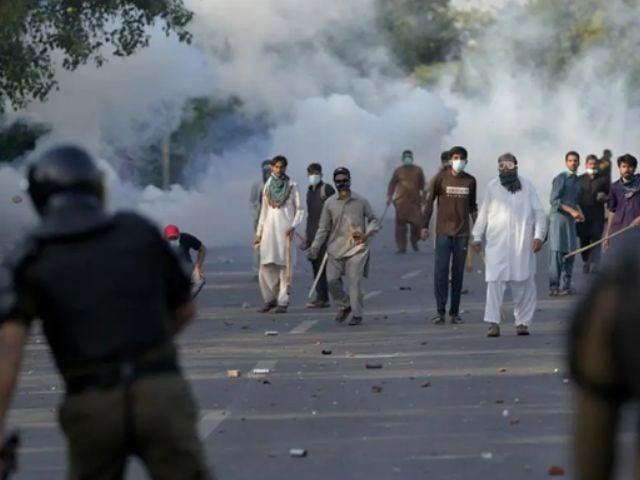
The violence on May 9, caused by the arrest of PTI’s newly appointed patron-in-chief in a corruption case, released unrest across the country, including unprecedented attacks on military installations.
The state’s response was quick and sweeping with a crash that led to the arrest of dozens of leaders and supporters, with many now facing anti-terrorism.
As beliefs begin to roll in, political analysts believe that the cost of staging fresh agitation is growing during the day.
Ahmed Bilal Mehboob, President of the Pakistan Institute of Legislative Development and Transparency (Pildat), sees this as a central moment.
“The government and the business have come stronger and more confident, especially after the recent [Pak-India] Four-Day War, “he said, adding” the support for agitation against government and the establishment of PTI and its allies also suffered further setbacks “.
In comments on the demand’s demand, the Pildat chief noted that there was a greater likelihood of harsher punishment for May 9 accused of persons and added, “This judgment is a sign of the future trend of harder actions”.
Mehboob felt that the vacuum at the top was another factor that put together the legal challenges for both Khan and the party.
As for the question of whether PTI’s call for protest would have traction, especially after the protection it did not require lecture with the establishment and then announced a protest movement from prison, Mehboob believed that Imran Khan is suffering from a lack of clarity in communication because he is unable to communicate directly from behind bars.
He noted that visitors tell Khan’s point of view with a sloping that reflects their personal views, which are often contradictory.
“Apparently, there is no clear and well -considered politics that the party has decided to follow,” he said, noting the reasons for constantly being confused signals from PTI.
Mehboob said it shows a confused state of mind that is completely natural in a situation where “the top leader is behind the bar and isolated; and the rest of the party officers lack confidence and authority to make a decision as Khan can bother and snub them at any time”.
Meanwhile, PTI’s relationship with powerful stakeholders has hit a new low.
An example of this was witnessed when the party was excluded from a high -level field marshal to celebrate victory in recent war, which the experts think was a symbolic, but tells Snub.
The only invitation expanded to PTI was sent to Khyber Pakhtunkhwa Chief Minister Ali Amin Gandapur. Still, he skipped the event to attend a party meeting discussing Khan’s release – an act that was considered by some as despite, but by others as a miss.
“PTI should decide to either act as a” revolutionary “party by choosing the path of street revolt (which in my opinion can be a suicide path) or act as a responsible political party that governs a province and can control the country again,” Mehboob said.
He said PTI should not miss his official tasks as a major political party and as the province’s government and participate in all such state ceremonies and meets as the dinner hosted by Field Marshal. “Attempts to ride in two boats can land the party in mud,” he concluded.
While sharing his views on the challenges that PTI faces, Professor Tahir Naeem Malik of Numl University said that the verdict on May 9 made it clear that the state would not go easy on PTI.
“The judgment on May 9 is not only legal judgments,” noted the professor, “they are part of a wider message that the state intends to pull a hard line.”
By commenting on Khan’s desire to hold direct conversations with the establishment, which was quickly followed by his announcement of starting a new protest movement, Professor Malik said it was the result of a lack of coordination among party leadership as they do not have frequent opportunities to devise political strategies in the midst of changing circumstances.
“The supreme leadership is in prison and is unable to take status over the rapidly changing situation, while outside they cannot make decisions on their own,” said Professor Malik, “this has created confusion, whether to negotiate or resist; thus to paralysis.”
Nevertheless, Malik said the support of voters is still there for PTI, but it seems that the party’s ability to transform it into action is reduced, adding that slogans alone will not be enough without proper coordination and a clear plan.
On Rifts, he said, with some kind of reconciliation or reset, it’s hard to see how PTI regains political space through traditional channels.


