
Prime Minister Sheikh Mohammed says inclusive engagement is essential to solving crises from Afghanistan to Gaza
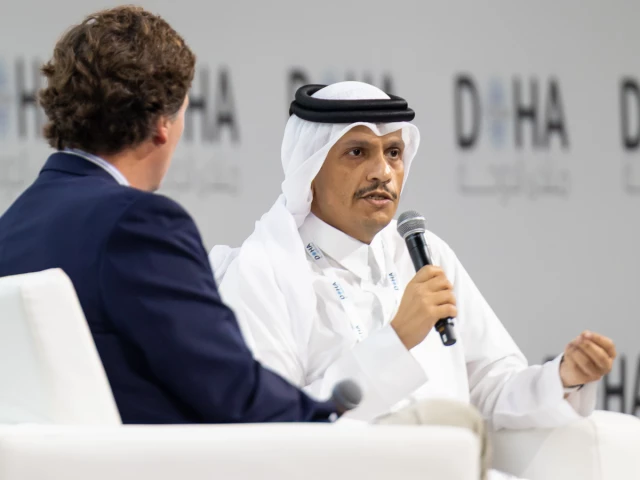
Qatar’s Prime Minister and Minister of Foreign Affairs, Sheikh Mohammed bin Abdulrahman bin Jassim Al Thani, speaks at the 23rd edition of the Doha Forum during a session moderated by American journalist Tucker Carlson. Photo: X
DOHA:
In a region grappling with conflicts from Afghanistan to Gaza, Qatar on Sunday pushed for inclusive political engagement, even with non-state actors, as the only realistic path to lasting stability.
Speaking at the 23rd edition of the Doha Forum, Qatar’s Prime Minister and Foreign Minister Sheikh Mohammed bin Abdulrahman bin Jassim Al Thani said lasting peace requires direct communication with all parties to a conflict, including armed groups often shunned by Western capitals.
In a session moderated by American journalist Tucker Carlson, Sheikh Mohammed said regional crises, whether in Afghanistan, Palestine or beyond, cannot be resolved by excluding key actors on the ground. “You can’t solve or come to a solution if you don’t have somebody talking to non-state actors,” he said.
Qatar is one of the mediators trying to seek a rapprochement between Pakistan and the Afghan Taliban regime. Sheikh Mohammed noted that Qatar’s long-standing approach to mediation has been shaped by this principle, which has underpinned its involvement in negotiations from the Afghan peace process to repeated cease-fire efforts in Gaza.
He explained that Qatar’s relationship with Hamas began more than ten years ago at the request of the United States, which wanted a reliable channel of communication with the Palestinian group. “When they moved their office back in 2012 here, it was only used for communications and to facilitate ceasefires and aid to Gaza,” he said.
Similarly, he continued, the Taliban’s political office in Doha, established in 2013, was also opened at Washington’s request during the group’s war with the United States and the former Afghan government.
Qatar hosted years of Afghan peace talks that eventually paved the way for the Doha agreement and US withdrawal from Afghanistan. These experiences, asserted Sheikh Mohammed, show the necessity of having a neutral platform for engagement with actors who “have real influence on the ground.”
Responding to allegations that Qatari funds meant for humanitarian aid in Gaza had been diverted to Hamas, the prime minister said emphatically: “All our aid, funding and all our support went to the people of Gaza and it was a very transparent process that the US is very aware of.”
He said that Israel itself had facilitated the distribution of funds and humanitarian aid to the besieged enclave. He criticized political actors who, he claimed, distorted Qatar’s role for domestic gain. “Politicians are trying to use this for short-term political gains … to fuel their narratives,” he said.
He stressed that Qatar’s mediation has delivered tangible results, including multiple ceasefires, humanitarian pauses, hostage releases and evacuation arrangements.
This Doha Forum brought together over 5,000 delegates from 162 countries, including presidents, prime ministers, foreign ministers, global political experts and heads of international organizations. The event, one of the Middle East’s most influential political platforms, explored conflict resolution, humanitarian crises, global governance and economic instability.
The prime minister also spoke about the Israeli attack on Qatari territory in September, describing it as a flagrant breach of diplomatic norms and the principles of mediation. “The mediator is being bombarded by one of the parties – this has been unprecedented,” he said. “It was an unethical move.”
Sheikh Mohammed revealed that US President Donald Trump had reacted with surprise and frustration when he learned of the Israeli actions. “President Trump expressed his frustration, his disappointment, because he knows all about the process and how helpful we were throughout,” he said.
Commenting on the devastation in Gaza following Israel’s two-year military campaign, he reiterated Qatar’s commitment to humanitarian aid, but said the burden of reconstruction must rest with the responsible party. “We will do whatever it takes to alleviate their suffering,” he said. “But we won’t write the check for what others have destroyed.”
He criticized the international community for what he described as a “double standard”, comparing calls for Russia to fund Ukraine’s reconstruction to the reluctance of many countries to hold Israel responsible for the reconstruction of Gaza.
According to UN estimates, 92% of Gaza’s residential buildings have been damaged or destroyed, generating up to 60 million tons of rubble. Experts believe that the reconstruction could take decades.
Sheikh Mohammed strongly opposed any attempt to forcibly expel Palestinians from Gaza. “They have the choice of where they want to go and they don’t want to leave their country,” he said. “I don’t see that anyone has the right to deport them or force them to go somewhere else.”
He stressed that Palestinians should not be treated as a people who can be “rocked or moved” at the convenience of regional powers.


