
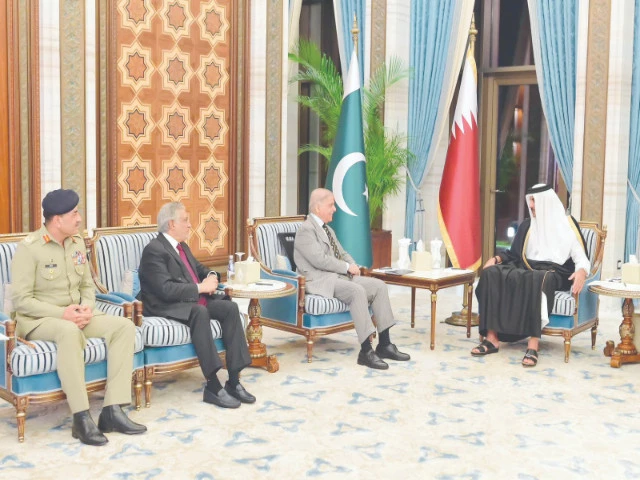
Prime Minister Shehbaz Sharif meets Qatar’s Emir Sheikh Tamim bin Hamad Al Thani in Doha; Deputy Prime Minister Ishaq Dar and Field Marshal Syed Asim Munir are also present. Photo: Express
ISLAMABAD:
Prime Minister Shehbaz Sharif held what he described as a “warm and productive” meeting with the Emir of Qatar, Tamim bin Hamad Al Thani, in Doha on Tuesday, with discussions spanning bilateral cooperation and the evolving regional situation.
In a statement released on X after the meeting, the prime minister said he had an “excellent meeting” with Qatar’s leader and stressed the desire of both sides to transform their “fraternal fraternal ties” into “mutually beneficial economic relations”.
“I was also joined by DPM/FM Senator Ishaq Dar and CDF Field Marshal Syed Asim Munir,” the prime minister noted, referring to the high-level delegation accompanying him.
According to the Prime Minister, the discussions focused on fostering political ties for stronger economic partnerships.
“Our most heated and productive discussions focused on how our two sides can promote our fraternal fraternal ties and transform them into mutually beneficial economic relationships,” he said.
The two sides also reviewed the wider regional situation.
“Pakistan and Qatar will continue to work together for peace and stability in the region and beyond,” the prime minister added without elaborating.
While the statement did not explicitly spell out specific regional flashpoints, it is understood that the ongoing tensions between Pakistan and Afghanistan, the Iran-US dispute and the efforts around a peace plan for Gaza figured in the discussions given the rapidly evolving security environment in the wider region.
Separately, an official statement issued after the prime minister’s meeting with Qatar’s prime minister and foreign minister, Mohammed bin Abdulrahman bin Jassim Al Thani, provided further details of the engagement.
The Prime Minister met Sheikh Mohammed bin Abdulrahman bin Jassim Al Thani during his official visit to Doha. Deputy Prime Minister Ishaq Dar, Chief of Army Staff and Chief of Defense Forces Field Marshal Syed Asim Munir, Federal Minister for Information and Broadcasting and Special Assistant to Prime Minister Tariq Fatemi were also present.
The two leaders held detailed discussions on bilateral relations and exchanged views on regional and international developments. They reaffirmed the strong fraternal ties between Pakistan and Qatar and expressed satisfaction over the growing momentum in political, economic and institutional engagement.
According to the statement, the talks focused on strengthening cooperation in trade and investment, energy, defence, labor mobility and cultural cooperation. The two sides also agreed to activate a joint task force with a mandate to accelerate cooperation across these sectors.
Both countries stressed the importance of implementing decisions made during recent high-level engagements and institutional mechanisms, including the Joint Ministerial Commission and bilateral political consultations, to ensure tangible progress.
Regional issues, including developments in Gaza and broader Gulf security dynamics, also came up for discussion. The Prime Minister appreciated Qatar’s constructive diplomatic efforts to promote dialogue and de-escalation in the region.
Qatar has in recent years positioned itself as a key mediator in regional conflicts, and Pakistan has consistently supported diplomatic initiatives aimed at reducing tensions in the Middle East.
Both leaders emphasized the importance of peaceful resolution of disputes and adherence to international law, including the UN Charter. The meeting reaffirmed the joint commitment of Pakistan and Qatar to further strengthen their strategic partnership and remain engaged and in touch on bilateral, regional and international issues.
The prime minister’s visit comes at a time of increased geopolitical movement, with multiple crises intersecting in South Asia and the Middle East. Against this backdrop, Islamabad appears eager to deepen coordination with Doha, a country that has played an increasingly prominent diplomatic role, while seeking to translate strong political ties into concrete economic gains.


