
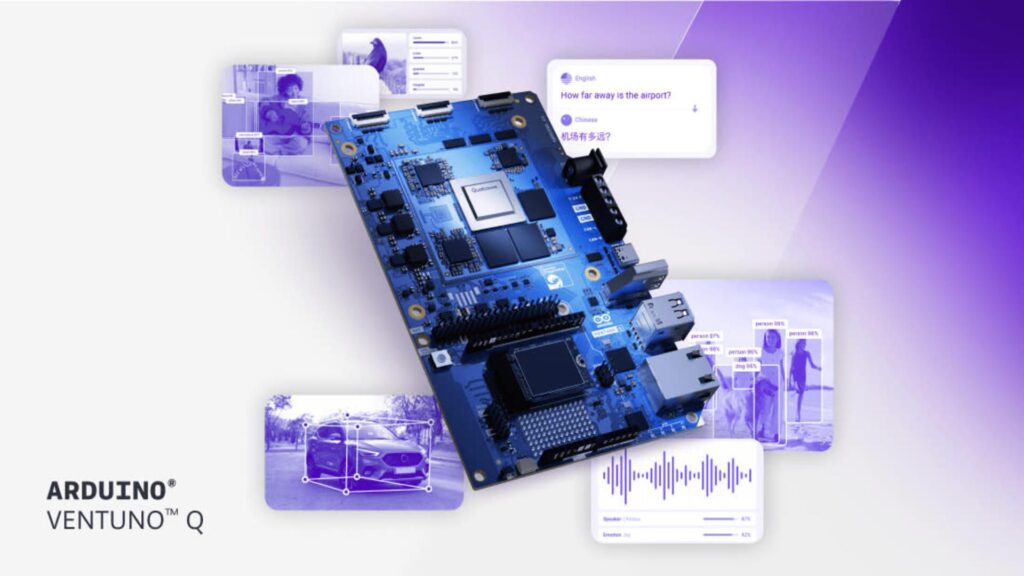
- VENTUNO Q runs fully autonomous AI agents completely offline without external servers
- The Dragonwing processor delivers up to forty dense TOPS of AI computation
- Robotic applications include vision-guided arms and autonomous machines that navigate complex environments
Qualcomm and Arduino have launched the Arduino VENTUNO Q, a single-board computer designed for robotics, generative AI and edge computing capable of operating fully offline.
The board uses the Qualcomm Dragonwing IQ8 Series processor and a dedicated STM32H5 microcontroller for deterministic control, enabling systems to perceive, decide and act on the same device.
Qualcomm says the neural processing unit delivers up to 40 dense TOPS of computing, supporting simultaneous inference and complex processing locally, while 16GB of RAM and 64GB of expandable storage handle demanding multitasking.
The article continues below
A new board built for edge AI workloads
Fabio Violante, VP and GM at Arduino, said the platform enables “systems that don’t just interpret the world, they interact with it,” enabling machines to function without reliance on cloud connectivity.
The architecture integrates AI acceleration with real-time microcontroller logic, unifying perception, decision and actuation on a single board.
VENTUNO Q can run fully autonomous AI agents for tasks including offline voice assistants, gesture-responsive smart mirrors and interactive kiosks at transport hubs, health offices or tourist centres.
The system supports robotic applications, including pick-and-place robotic arms controlled by vision and service robots capable of following individuals across dynamic spaces.
It also enables autonomous machines to navigate complex environments using Visual SLAM combined with path optimization.
Edge AI vision systems are also possible, enabling proactive safety monitoring, traffic observation and automated quality inspections with local visual language models.
All these functions are handled on the board, eliminating the need to transfer data to external servers.
VENTUNO Q runs Ubuntu and Debian Linux on its main processor and Arduino Core on Zephyr OS for real-time control.
Arduino App Lab supports Python scripts, Arduino sketches, and ready-to-use AI models, including gesture recognition and object tracking.
It also supports local LLMs powered by the Qualcomm AI Hub, while Edge Impulse Studio allows training custom models.
Industrial I/Os, multiple MIPI CSI camera connectors, audio, displays and 2.5 Gb Ethernet provide extensive hardware compatibility.
“With VENTUNO Q, AI can finally move from the cloud to the physical world. This platform makes it possible to build machines that perceive, decide and act, all on a single board,” said Fabio Violante, VP & GM, Arduino, Qualcomm Technologies, Inc.
“Our goal is to make advanced robotics and edge AI accessible to every developer, educator and innovator. VENTUNO Q is the natural evolution of Arduino’s mission and a big step towards bringing real-world intelligence to everyone.”
VENTUNO Q is compatible with Arduino UNO shields, Modulino nodes, Qwiic sensors and Raspberry Pi HAT extensions.
It will be available in Q2 2026 through the Arduino Store and other authorized resellers such as DigiKey, Farnell, Mouser Electronics and RS Components, although the board’s practical impact on existing platforms such as the Raspberry Pi remains uncertain.
Follow TechRadar on Google News and add us as a preferred source to get our expert news, reviews and opinions in your feeds. Be sure to click the Follow button!
And of course you can too follow TechRadar on TikTok for news, reviews, video unboxings, and get regular updates from us on WhatsApp also.


