
Province ends queues, paperwork with Civil Registration Management System mobile application
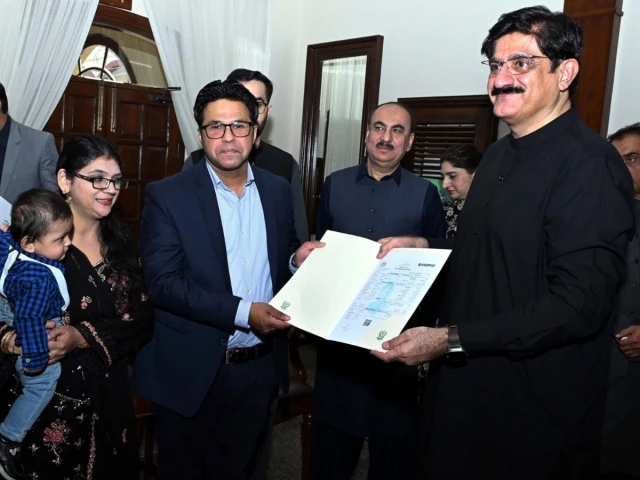
Sindh CM Murad Ali Shah presents a birth certificate to a parent during a launch of Civil Registration Management System (CRMS) Mobile Application at CM House in Karachi on November 28. PHOTO: PPI
KARACHI:
In a major push towards digital governance, Chief Minister Murad Ali Shah launched the Civil Registration Management System mobile application – a platform that now enables citizens to register birth, death, marriage and divorce online without visiting any government or relevant office.
Calling the initiative a ‘milestone in Sindh’s transition to a digital future’, the chief minister said the system would eliminate queues, paperwork and delays and make essential services available to people across the province, especially those living in remote and underserved areas.
Registration at the door
The Civil Registration Management System (CRMS) mobile app, developed in collaboration with NADRA, is part of the larger Electronic Civil Registration and Vital Statistics System (e-CRVS) approved at a cost of Rs471 million. The system will cover 30 districts and 769 health facilities, ensuring that 85% of births taking place in public and private hospitals are digitally recorded.
Read: PTA terms tariff increase by mobile operators “justified”
Shah said the app would also integrate vaccination records, disease surveillance and patient identity management — enabling accurate, real-time data critical for planning and public health.
“Civil registration has long been low because many less privileged families could not afford NADRA fees,” the Chief Minister observed. “To remove this barrier, the Sindh Cabinet decided that the provincial government will pay all NADRA fees for birth and death registration.”
Mandatory birth registration within hours
The Chief Minister announced that birth registration would be made mandatory in Sindh immediately after the birth of the child. “In five years, every child’s school mapping and planning will be based on this data,” he said, directing hospitals to ensure immediate registration of all newborns.
He added that implementation at association council level would be crucial and that the performance of local representatives would now be assessed based on enrollment rates.
Shah highlighted that all Sindh Cabinet meetings have already shifted to fully paperless system. The provincial government is now aiming to extend digital reforms to issuing domicile, social protection systems, health records, licenses and e-payments – consolidating them under a secure, unified digital platform.
NADRA, he said, has been an ‘essential partner’ through solutions like Pak-ID and will ensure that its data security and privacy standards also extend to the new system.
The healthcare sector to benefit from integrated data
The provincial health minister Dr. Azra Fazal Pechuho briefed the Chief Minister about the network of 769 health facilities now connected to the new system. The integrated data, she said, would support programs such as the Electronic Immunization Registry and help target interventions for diseases including thalassemia.
NADRA Director General Amir Ali Khan and Local Government Secretary Waseem Shamshed signed a further agreement confirming NADRA’s role in securing and maintaining the CRMS mobile application. All terms of the original memorandum of understanding remain intact.
Chief Secretary Asif Hyder Shah said the Digital Sindh initiative would ensure both transparency and accuracy in governance processes.


