
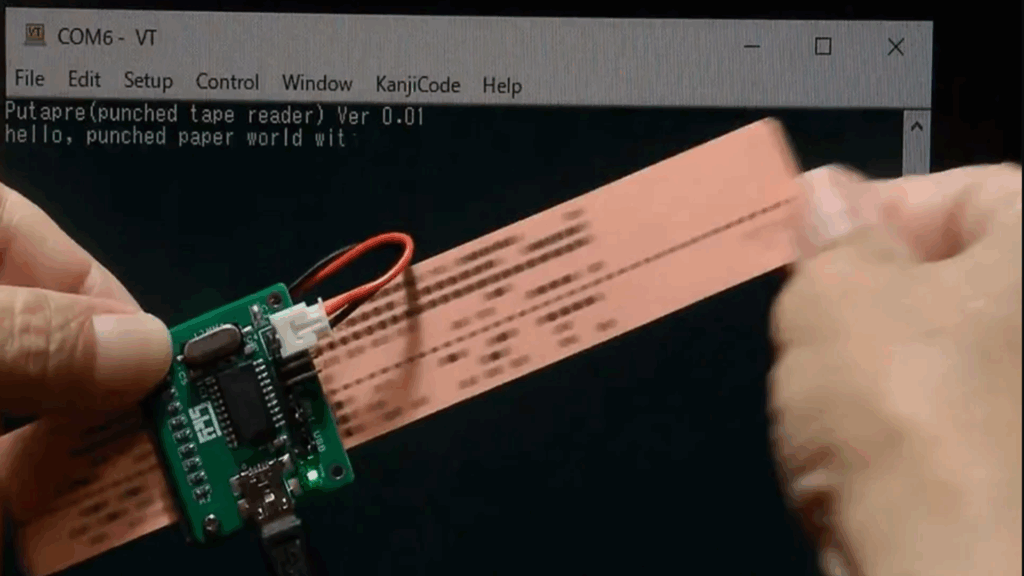
- New custom tape reader relies on a minimal optical setup using modern parts
- LED tuning and sensor calibration required serious patience during early testing phases
- Crosstalk reduction became a key factor in stabilizing signal accuracy consistently
A retro computer enthusiast has built a novel perforated tape reader that relies on a minimal set of modern components called Putapre.
The device comes from Skyriver, who wanted a simple optical system capable of handling perforated tape without the complexity of vintage contact mechanisms.
Its design uses an 8-bit PIC18 microcontroller connected via USB and relies on a phototransistor paired with an infrared LED to detect each hole in the ribbon with controlled light passing through the paper.
How the optical system was tuned for accuracy
Skyriver explains that it took a long time to get the lighting and sensor balance right – the LED power required repeated adjustments to avoid false triggers, while the phototransistor sensitivity had to be configured to detect accurate transitions.
The manufacturer also focused on reducing crosstalk between channels, which required several hardware adjustments.
The choice of tape material proved important because different papers reacted differently to the light path, and after several trials the system reached a point where the tape could pass through cleanly with consistent readings.
To stabilize the tape, Skyriver created a 3D-printed guide that keeps the material aligned with the LED and sensor.
The guide ensured that the tape does not shift during movement and allows the optical path to remain stable throughout the feed.
With this mechanical support in place and some practice in handling the setup, the reader became predictable enough for demonstration.
Skyriver notes that these tweaks were critical to getting any reliable performance from the hardware.
The software responsible for interpreting the signals currently performs only the essential operations, but Skyriver is committed to improving it later.
Early estimates indicate that the reader operates at around fifty bytes per second, meaning that users should not expect high data reading speeds.
However, this speed is still faster than older contact systems, but remains modest by any modern standard.
Perforated tapes occupied an important place in early computing before magnetic media replaced them, and they still attract interest among enthusiasts.
Skyriver suggests designing a compact punching device so that ribbons can be produced without the use of vector files and laser cutters.
That said, the output of this project is quite slow and its purpose is very narrow, suggesting that it will have limited practical value.
Still, it reflects the appeal of rebuilding historical technology for experimentation rather than efficiency.
Follow TechRadar on Google News and add us as a preferred source to get our expert news, reviews and opinions in your feeds. Be sure to click the Follow button!
And of course you can too follow TechRadar on TikTok for news, reviews, video unboxings, and get regular updates from us on WhatsApp also.


