
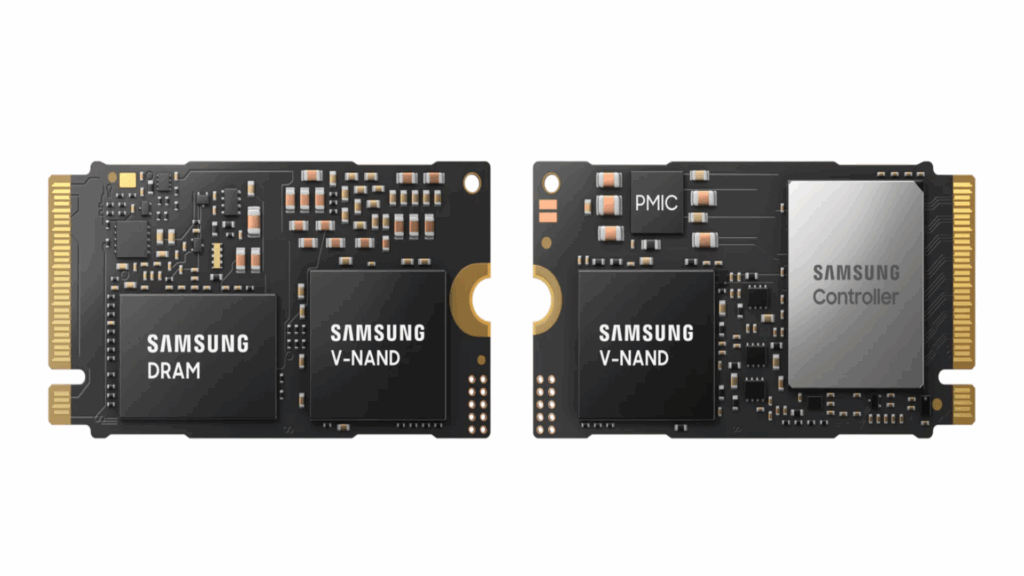
- Samsung PM9E1 delivers PCIe Gen5 performance within an exceptionally small 22 x 42mm footprint
- Double-sided component placement enables high capacity despite severe physical space limitations
- Specialized PCB materials help mitigate mechanical stress during prolonged thermal cycling
Samsung’s PM9E1 NVMe Gen5 SSD quietly appeared in 2024, surprising the industry when the company went into mass production without a major announcement.
This model followed the PM9A1 SSD launched in 2021 and introduced improvements in speed, capacity and power efficiency.
The drive measures just 22 by 42 millimeters, a significant reduction compared to previous M.2 2280 designs, yet it integrates a full SSD architecture optimized for high-performance workloads.
Technical challenges and thermal management
Engineers used a double-sided layout that mounted NAND, DRAM and power management components on both sides of the compact circuit board to achieve capacities of up to 4TB.
Integrating all essential components into such a small form factor required careful thermal management and mechanical reliability considerations.
The development team generated detailed heatmaps from mock samples to optimize power distribution and account for heat-sensitive components.
Special PCB materials with low thermal expansion and side filling technology were implemented to minimize deformation and ensure long-term reliability.
The SSD maintains high throughput under extended workloads without throttling, even under demanding AI processing or high data transfer scenarios.
The PM9E1 is designed specifically for performance-driven AI workloads, supporting sequential write speeds of up to 12.6 GB/s and sequential read speeds reaching 14.5 GB/s.
These properties facilitate fast loading of large AI models and smooth inference on the device.
“The PM9E1 is a storage solution that achieves both an ultra-small form factor and high capacity through advanced double-sided design technology,” said ChangWoo Sun, Project Manager of the Samsung Memory Product Planning Team
“In particular, it will serve as a core solution with high performance and low power consumption across a wide range of applications – from mobile devices to ultra-slim notebooks and edge servers”.
In addition, the SSD’s low power consumption complements modern CPUs used in compact, high-performance systems.
The architecture addresses both efficiency and capacity, providing a high-speed storage option suitable for ultra-slim notebooks, AI edge servers and other space-constrained platforms.
Despite its performance and compact design, the PM9E1 remains a specialized solution – its ultra-small form factor and dual-sided configuration push technical boundaries, but such a design also complicates mass production.
The SSD demonstrates Samsung’s ability to optimize storage density and efficiency, but widespread use will depend on system integration and market readiness.
That said, the PM9E1 provides clear high-capacity storage advantages, although its initial impact on consumer platforms may be limited by manufacturing and design constraints.
Follow TechRadar on Google News and add us as a preferred source to get our expert news, reviews and opinions in your feeds. Be sure to click the Follow button!
And of course you can too follow TechRadar on TikTok for news, reviews, video unboxings, and get regular updates from us on WhatsApp also.


