
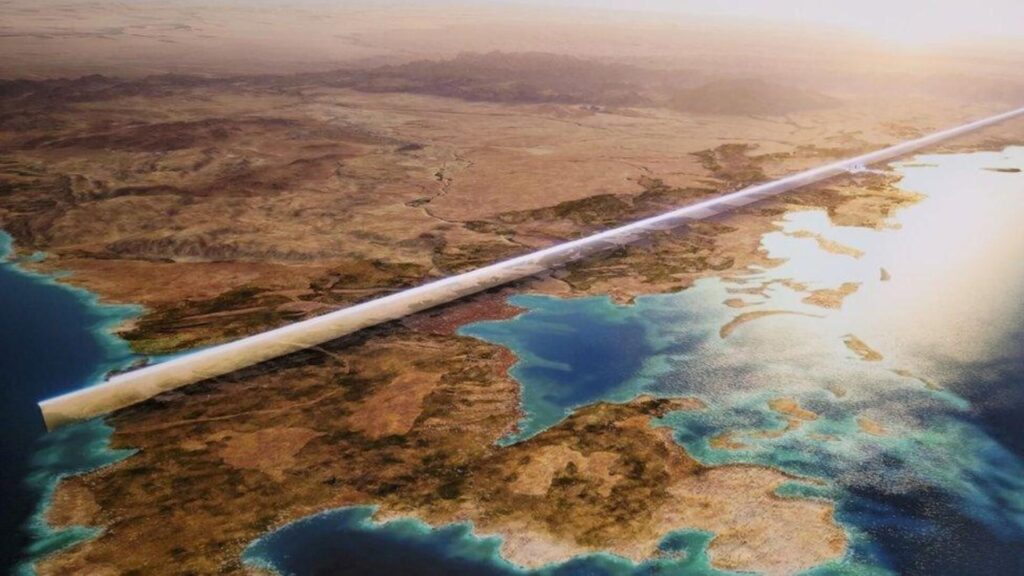
- Saudi Arabia may trade residential plans for an industrial and artificial focus
- The desert nation is investing heavily in GPUs for government-backed AI facilities
- Coastal access offers potential seawater cooling for desert data centers
Saudi Arabia’s Neom project, known as “The Line”, was originally described as a linear urban development stretching some 170 km across the desert.
The concept envisioned a linear city of extreme density, automated mobility and renewable energy that would accommodate 9 million inhabitants within its narrow footprint.
But reports now suggest officials are rethinking that vision after internal investigations revealed delays, rising costs and broader fiscal pressures — and sources cited by Financial Times says the revised plan may abandon large housing ambitions in favor of far less industrial use.
Focus on AI infrastructure and data centers
In this context, planners reportedly view the site as a hub for cloud hosting and large data centers designed to support intensive computing workloads.
It is likely to prioritize high-density server installations for AI training and inference over residential or urban services.
Some accounts suggest that operators will prefer bare metal infrastructure to maximize performance and utilization efficiency.
Saudi Arabia has recently accelerated investment in AI capabilities, including the acquisition of thousands of advanced GPUs for government-backed facilities.
However, Saudi Arabia’s climate poses a well-documented challenge to data center operations, especially given persistently high temperatures and limited availability of fresh water.
Independent research has identified the country as one where most existing data centers operate in zones deemed inefficient for cooling.
But The Line’s coastal access to the Red Sea provides a practical advantage, with planners proposing seawater cooling as a mitigation strategy.
Similar projects, such as xAI’s Colossus in Memphis, have been investigated after satellite controls suggested limits on available electricity or cooling capacity for AI systems.
Whether the scaled-down data center will reach full capacity remains unclear, but Saudi Arabia chose to put The Line on hold in favor of a smaller plan.
The desert nation has faced a liquidity squeeze after years of expansive public spending, while lower oil revenues and competing commitments such as the Expo fair and the 2034 World Cup added pressure.
Neom did not directly challenge demands for reduced scope, but instead emphasized incremental development and adaptation to national priorities.
This approach suggests flexibility rather than a firm commitment to the original scale or timeline.
Observers note that similar adjustments have already occurred across other Saudi megaprojects.
But with no clear confirmation of the original plan, speculation has grown that the linear city model may no longer be at the center of Neom’s strategy in the near term.
Follow TechRadar on Google News and add us as a preferred source to get our expert news, reviews and opinions in your feeds. Be sure to click the Follow button!
And of course you can too follow TechRadar on TikTok for news, reviews, video unboxings, and get regular updates from us on WhatsApp also.


