
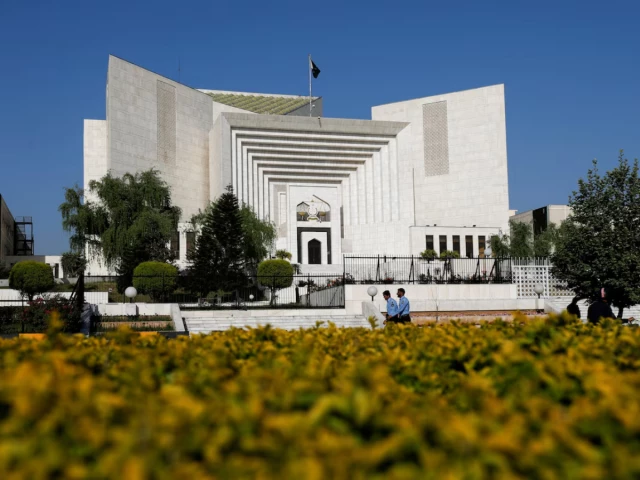
Police officers walk past the Supreme Court of Pakistan building in Islamabad, Pakistan April 6, 2022. REUTERS
ISLAMABAD:
After spending 15 years behind bars, four men accused of murdering six police officers in a terror case have been acquitted by the Supreme Court, which found the prosecution’s case riddled with inconsistencies and lacking credible evidence.
In an eight-page judgment authored by Justice Ishtiaq Ibrahim, the SC set aside the Lahore High Court’s decision that had upheld the death sentences of the accused, ruling that the case was riddled with serious legal and evidentiary flaws.
“The prosecution has failed to lead independent evidence, either direct or circumstantial, which could reasonably connect the appellants with the commission of the offence. The evidence adduced by the prosecution is replete with material inconsistencies and inherent improbabilities which cast serious doubt on the correctness of the prosecution’s case,” the judgment said.
The court noted that it is a well-settled principle in criminal jurisprudence that if a single circumstance creates reasonable doubt in a prudent mind as to the guilt of the accused, the benefit of such doubt must go to the accused.
Such a benefit, it added, must not be extended as a matter of grace or concession, but as a matter of right.
“The learned courts below, although they have not drawn attention to the aforesaid weaknesses and substantial doubts in the prosecution’s case, have thus committed a grave error of law in finding the appellants guilty of the offenses charged against them,” the judgment said.
A three-member bench headed by Justice Muhammad Hashim Kakar found serious flaws in the prosecution’s case.
The court noted that the two key witnesses were not in uniform and were unarmed at the time of the incident as they had finished their patrol duty and were at the hotel in plain clothes.
“Secondly, since one police officer had already lost his life and five police officers were lying in a seriously injured condition in the hotel, the version of the alleged eyewitnesses that they immediately started chasing the assailants seems very unnatural and does not appeal to a prudent mind.”
The bench observed that such conduct is contrary to the normal human conduct.
Furthermore, it added, the version of the alleged eyewitnesses regarding the identification of the assailants also appears questionable. According to them, the assailants had suddenly arrived at the scene and immediately resorted to indiscriminate firing.
The bench observed that in such a situation where the entire episode allegedly took place within a very short span of time and during a sudden and life-threatening attack, it does not appeal to reason that the alleged eyewitnesses could closely observe and remember the minute details of the assailants such as their height, age, complexion and the clothes they were wearing.
In such a situation, a person’s normal behavior is to save his own life instead of carefully noting the attackers’ physical features, the court added.
“Nor have the alleged eyewitnesses established their presence at the scene of the incident through any independent or unimpeachable evidence.”
The judgment further noted that a major flaw in the prosecution’s case was the manner in which the identification parade was conducted.
“It is now a well-settled principle of law that the identification parade of each accused person must be held separately and that a joint identification parade of several accused persons is unsafe and unreliable. Such a practice has been consistently rejected by this Court. The holding of a joint identification parade has been repeatedly condemned by this Court.”


