
National Judicial Policy Making Committee Approves Judicial Savings and Energy Savings Plan
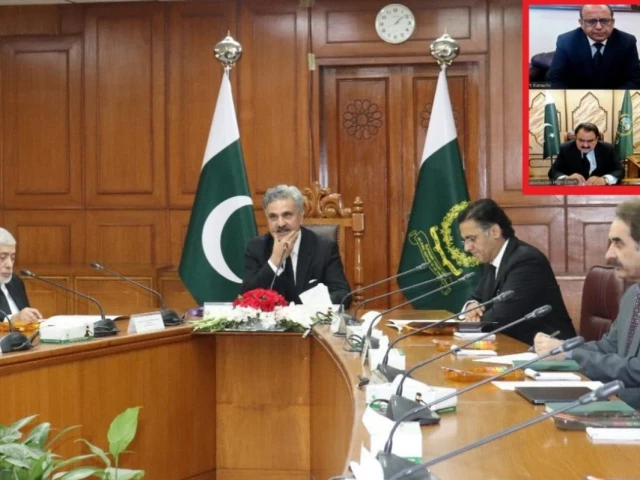
Chief Justice of Pakistan Yahya Afridi chairs a meeting of the National Judicial (Policy Making) Committee at the Supreme Court of Pakistan on Tuesday. Photo: Supreme Court of Pakistan
In line with the government’s announced austerity measures due to disruptions in the supply of petroleum products, the Supreme Court of Pakistan also announced similar measures on Tuesday, adopting a four-day work week from Monday to Thursday.
Prime Minister Shehbaz Sharif announced a day earlier a series of steps as part of a wider austerity plan to deal with the situation arising from the fuel crisis linked to the ongoing crisis in the Middle East following attacks by the US and Israel on Iran. During a meeting attended by representatives of the federal and provincial governments, the prime minister announced a four-day work week and a work-from-home policy as part of sweeping austerity measures.
According to a statement issued by the Supreme Court, the National Judicial Policy Making Committee (NJPMC) under the chairmanship of Chief Justice of Pakistan Yahya Afridi met in an inaugural virtual meeting.
The meeting, attended by the Chief Justice of the Federal Sharia Court, the Chief Justices of all High Courts and the Advocate General of Pakistan by special invitation, approved a comprehensive “Judicial Austerity and Energy Conservation Strategy” aimed at ensuring responsible use of national resources while maintaining uninterrupted access to justice throughout the country.
Read: Pakistan expands austerity efforts as fuel prices rise and global oil markets turn volatile
“It reflects the institution’s proactive response to the anticipated disruption of oil supplies and rising global energy costs, underscoring the Judiciary’s commitment to national resilience and institutional responsibility.”
Recognizing that the judicial sector must lead by example in times of economic and energy uncertainty, “the NJPMC decided that courts across Pakistan will adopt a series of practical measures designed to reduce fuel consumption, limit operational costs and promote efficient use of resources without compromising the delivery of justice,” the statement read.
The committee emphasized that these measures represented the Judiciary’s institutional commitment to prudent governance, environmental responsibility and solidarity with the broader national effort to conserve energy and public resources.
“By adopting these measures across the justice system, the NJPMC confirmed that access to justice will remain uninterrupted even as the judiciary aligns its internal operations with the principles of efficiency, sustainability and responsible governance,” the Supreme Court’s press release said.
After the meeting, the Supreme Court issued a notification regarding the measures with immediate effect.
“In light of likely disruptions in the supply of petroleum products resulting in escalating energy costs, it is imperative to adopt prudent and responsible measures to conserve resources,” the statement read.
According to the directives, the court will observe a four-day working week (Monday to Thursday) to reduce fuel consumption and operating expenses. “The court shall observe public holidays from Friday to Sunday,” it added.
However, while ensuring that urgent judicial and administrative functions continued without interruption on Fridays and Saturdays, the courts may take necessary internal management measures keeping in mind their operational priorities.
Likewise, the District Courts would work four days a week (Monday to Thursday) at full capacity, while the respective High Courts would keep their human resources to a minimum on Fridays and Saturdays according to workload and performance benchmarks.
The announcement said the monthly cap of Petroleum, Oil and Lubricants (POL) allocated to magistrates and eligible officers would be reduced by 50%, while additional security or protocol vehicles were banned.
Also read: Sindh announces school closure from March 16 to 31, government staff to work from home on Fridays
“No additional protocol or security vehicles may be deployed during movement within designated high security zones,” the release said, adding that the affected neighborhoods must ensure route security as per the required protocols.
The court also encouraged litigants and lawyers to attend proceedings through video link facilities where possible, along with rotating attendance by court staff.
“Rotating attendance arrangements for staff where possible to minimize commuting and reduce energy consumption while maintaining essential court functions,” it added.
In its statement, the apex court also announced similar measures for the Federal Sharia Court and the High Courts.
“The monthly ceiling of POL awarded to Honorable Judges of the Federal Sharia Court and the High Courts shall be reduced by 50% while that of Judges by 25%,” it said.
Read more: OGRA dismisses reports of Rs73 petrol, Rs84 diesel hikes as ‘completely baseless’
The court also rationalized the security and protocol of the Federal Sharia Court and the High Courts, but allowed an exception in view of the recent security situation in Balochistan and Khyber Pakhtunkhwa.
“While the Federal Sharia Court and the High Courts must rationalize security and protocol, the Honorable Judges and Judicial Officers serving in Khyber-Pakhtunkhwa and Balochistan must maintain their security as the case may be.”


