
Judge Panhor believed in his dissent note that the case was a rape, that the sentence should have been upheld
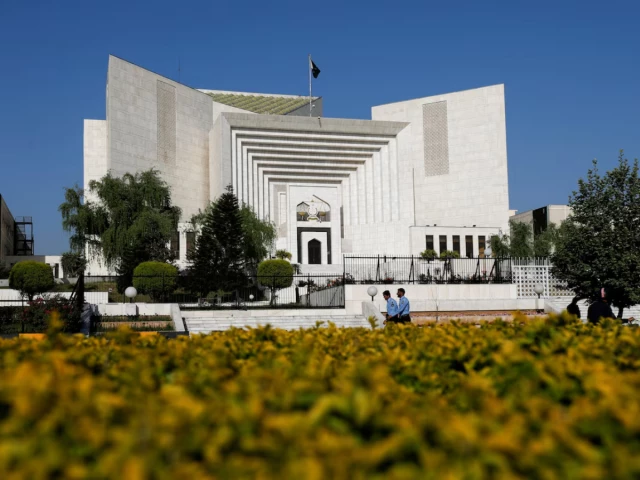
Police officers walk past the Supreme Court of Pakistan building in Islamabad, Pakistan April 6, 2022. REUTERS
ISLAMABAD:
The Supreme Court has converted a rape conviction into a case of adultery, reduced the sentence for the accused from 20 years’ imprisonment to five years’ rigorous imprisonment and lowered the fine from Rs 500,000 to Rs 10,000. In the event of non-payment, the defendant must be sentenced to an additional two months in prison.
According to a six-page detailed judgement, authored by Justice Malik Shahzad Khan and approved for reporting, the majority of the court held that the evidence did not prove the crime of rape but established consensual sexual relations.
However, Judge Salahuddin Panhor dissented from the majority decision.
The court noted that although in the case of consensual adultery the complainant may also be punished, in the present case the complainant was neither challenged nor given the opportunity to defend himself during the trial. Therefore, the Supreme Court ruled that no punishment could be imposed on her at the appeal stage without a hearing being granted.
Referring to the facts of the case, the court observed that the FIR was lodged almost seven months after the alleged incident. The prosecution failed to explain how the accused knew that the complainant would be present at the scene at a particular time.
In the judgment, it was pointed out that the complainant did not resist during the incident, no signs of violence or injuries were found in the medical report, and the complainant’s clothes were neither presented as evidence nor shown in pieces.
Judge Salahuddin Panhor held in his dissenting note that the case involved rape and that the sentence should have been upheld.
He noted that many rape cases are not reported due to social pressure, stigma and intimidation and delay in filing an FIR should not be used against the victim. He also noted that the lack of resistance in the presence of a weapon and the absence of injuries after months were not unusual in such cases.


