
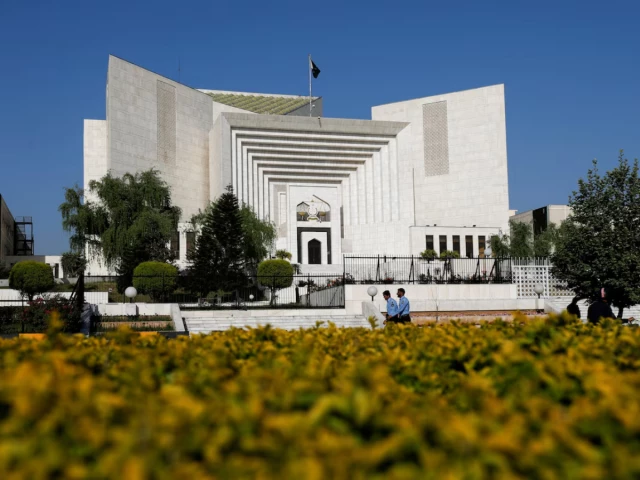
Police officers walk past the Supreme Court of Pakistan building in Islamabad, Pakistan April 6, 2022. REUTERS
ISLAMABAD:
The Shariat Appellate Bench of the Supreme Court on Monday issued notices to the federation in an appeal challenging the Federal Shariat Court’s (FSC) decision declaring the quota system un-Islamic and adjourned the hearing to the first week of April.
A five-member bench headed by Justice Jamal Khan Mandokhail heard the case. Other members of the bench included Justice Shahid Waheed, Justice Irfan Saadat Khan and Islamic scholars Justice (retd) Dr. Khalid Masood and Dr. Qibla Ayaz.
During the proceedings, Justice Mandokhail observed that the issue was of great national importance and asked Additional Attorney General (AAG) Munawar Iqbal Duggal to explain how the quota system could be justified under Islamic principles.
The lawyer argued that Article 27 of the Constitution explicitly prescribes the quota system and empowers Parliament to legislate in this regard. He further argued that legislation had already been passed to extend the duration of the quota system.
Justice Mandokhail noted that the original 40-year period of the quota system had already expired. Justice Irfan noted that the quota system was based on population ratio; The AAG responded that quotas were indeed implemented according to the province’s population.
Justice Mandokhail questioned whether the policy effectively conveyed a message that provinces with smaller populations should increase their numbers to ensure greater representation.
The appeal was filed by the federal government against the Federal Sharia Court’s ruling declaring the quota system contrary to Islamic injunctions. The court adjourned further hearing of the case to the first week of April after issuing formal notices.
The same Shariat Appellate Bench also issued notices to the Federation and all provinces in an appeal challenging the FSC judgment declaring the government’s power to commute sentences un-Islamic.
During the hearing, Justice Mandokhail noted that under Islamic law, punishments fall into two categories: those prescribed in the Holy Quran and those awarded under tazir.
He noted that in tazir cases, the judge decides the sentence taking into account the circumstances of each case. He questioned how an accused person could seek remission of sentence from the government. “If such a practice is allowed, the courts will become redundant,” he said.
He further noted that a person who is himself a party to a case cannot have his sentence quashed as this would lead to the breakdown of the justice system.
Justice Irfan noted that while compromise may be possible in murder cases, offenses such as robbery could not be settled through reconciliation.
Justice Mandokhail added that if a victim approached the state for justice after a theft and later discovered that the government had withdrawn the case, it would amount to denial of justice.
Justice Waheed directed the parties not to take the case lightly and come prepared with full arguments. Justice Mandokhail noted that the cases dated back to 1989 and said efforts would be made to hear them on a daily basis.
The bench clarified that it would not seek an opinion from the Council of Islamic Ideology (CII), noting that it would not be appropriate for the court to disagree with such an opinion.
The case relates to Sections 401 and 402 of the Pakistan Penal Code and the Penal Code (Amendment) Act, 1958, which Syed Islamuddin challenged before the FSC. In 1991, the FSC declared the relevant provisions un-Islamic.
The federal government challenged the 1991 judgment in the Supreme Court that same year. The Shariat Appellate Body adjourned further hearing of the case to the first week of April after issuing notices to all parties concerned.


