
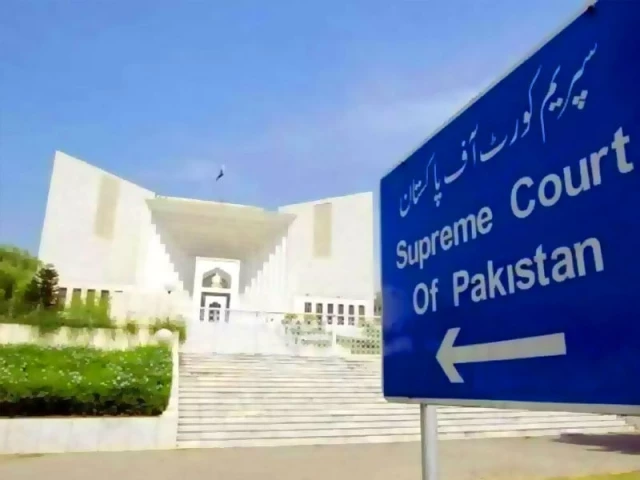
ISLAMABAD:
The Supreme Court has held that the State is bound to act as a model employer, especially in matters affecting promotion and service rights and entitlements, and cannot justify inaction or delay on the basis of internal inefficiencies.
It also noted that where the government acts as an employer, it is held to a higher standard of fairness, equity and accountability.
“Public institutions and officials are required to ensure that promotion processes are conducted timely, rationally and in accordance with the law, rather than allowing delay or inaction to defeat legitimate service rights and compel courts to obtain relief that should have been granted in the ordinary course,” said a seven-page judgment authored by Just the Punice While Service. Tribunal’s decision to deny promotion to Grade 14 employee in Irrigation Department.
A three-judge bench of the Supreme Court headed by Justice Ayesha observed that the court could not appreciate the fact that the petitioner was wrongfully deprived of the promotion to the post of Reporter (BPS-14) from the date of convening of the first Departmental Promotion Committee (DPC) viz. on January 22, that the promotion 21 does not take effect from January 22, 21. 2012.
The court noted that according to the World Justice Project Rule of Law Index 2025, Pakistan ranks 130 out of 143 countries in overall rule of law performance, while in the civil justice factor – which measures availability, efficiency of delivery and absence of unreasonable delay – it ranks 129 out of 143 countries.
“Similarly, the Worldwide Governance Indicators (WGI), developed by the World Bank, treat government effectiveness as a central measure of good governance, focusing on the quality of public administration, the competence of civil servants and the capacity of institutions to implement decisions in a timely and predictable manner, against which Pakistan’s percentile ranking in relation to this public administration is 101 in relation to public administration in relation to 301. systems are expected to operate in accordance with the principles of good governance The Organization for Economic Co-operation and Development (OECD) principles of public administration emphasize a merit-based public service and require that career management processes, including promotion, operate through clear, predictable and timely procedures.
“The United Nations Department of Economic and Social Affairs Principles of Good Governance emphasize efficiency, accountability and transparency in the administration of public employment.
In addition, Sustainable Development Goal 16 (SDG-16) emphasizes the importance of efficient, accountable and transparent public institutions and emphasizes that good governance is assessed by the capacity of state institutions to perform their functions in an effective and reliable manner.”
The judgment observed that measured against these standards, the Punjab Irrigation department’s failure to allow the petitioner to proceed on the present charge for several years reflects administrative inaction and institutional inefficiency. Such a failure cannot be allowed to prejudice an officer who was otherwise entitled.
“By reiterating international standards and obligations, the purpose is to remind the state of the obligations it has undertaken and the need for institutional compliance with principles of efficient, fair and accountable public administration followed globally. Such obligations reinforce the requirement that promotion processes be carried out in a timely and transparent manner and that eligible officials are not degraded by administrative negligence.”
The court also said that promotion is a natural progression in a civil service.
“It is an integral incident of service and every civil servant who meets the prescribed criteria of fitness, eligibility and seniority has a legitimate expectation of being considered for promotion within a reasonable time. When the grant is delayed due to inefficiency, maladministration or inaction, it affects the right of the civil servant to be considered and a failure to meet that justification, without legal justification and justification. procedural unfairness,” it is stated in the judgement.
“Where promotion is lost solely due to administrative oversight, such as a delay in convening the DPC, despite justification, justice demands that the omission be rectified. Unwarranted delay in promotion proceedings causes serious hardship to civil servants, especially those nearing or post-retirement, and leads to avoidable and repetitive litigation,” it added.
“Sanctioned positions exist to meet defined functional needs and must be filled promptly as long as they remain operational and are not legally frozen or abolished.”
The court noted that the petitioner in this case had the current charge of the post from 2008 to 2019 when he was actually promoted to the post, which also speaks volumes for the delay and negligence on the part of the respondents (provincial departments) who allowed him to work on the current charge but did not consider him for promotion to the post in 2012.
“Therefore, the delay cannot be attributed to the petitioner. It is entirely the result of negligence and inefficiency on the part of the department and in relation to the law laid down by this Court that an officer does not bear the consequences of internal administrative lapses.
“Unexplained delay in decision-making affecting career progression is itself a form of unfairness. It denies an eligible official timely consideration for promotion, undermines merit-based progression, and places the individual in a prolonged state of uncertainty. Such delay impairs equal opportunity in the service and cannot be treated as part of the mere delay of promotion. Purpose amounts to a denial of fair and equal treatment in accordance with the law and violates sections 4 and 25 of the constitution,” the judgment read.
The order noted that the state cannot therefore rely on the law to defend its own inaction or inefficiency to deny fair compensation for advancement once the prescribed eligibility criteria are met.


