
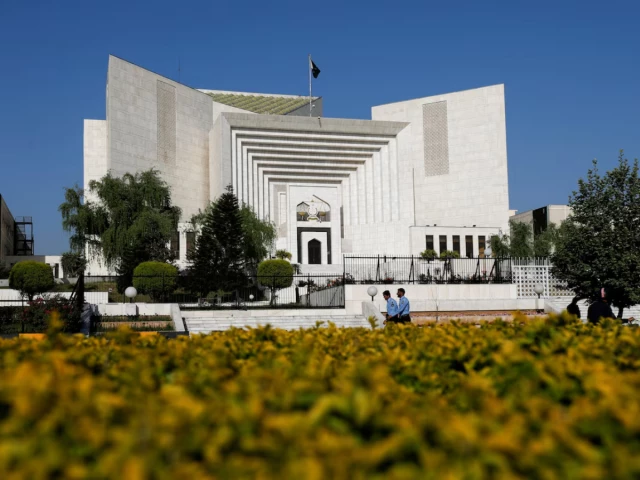
Police officers walk past the Supreme Court of Pakistan building in Islamabad, Pakistan April 6, 2022. REUTERS
ISLAMABAD:
Following the passage of the amendment, the Chief Justice of Pakistan Yahya Afridi convened a full court hearing on 15 November. However, Supreme Court justices could not agree to comment on the 27th constitutional amendment.
Perhaps for the first time, the entire hearing was held in the CJP’s chamber, where more than a dozen judges were present.
It is learned that two suggestions were given to the SC judges during the meeting.
The first was about collective resignation. The second was about the approval of the proposed statement regarding the 27th Amendment.
The Proposed Statement indicated that the 27th Amendment to the Constitution has been passed by Parliament, which is binding, and that the Federal Constitutional Court (FCC) has been established, and any challenge to the 27th Amendment will go to the FCC.
However, no consensus could be reached on the proposed statement. A section of judges was of the view that the proposed declaration would be an endorsement of the 27th constitutional amendment.
In order to avoid dissenting opinions, the opinion on the change could not be given. Sources also confirmed that the idea of collective resignation was put to the judges during the meeting.
It is also learned that CJP Afridi did not read Justice Salahuddin Panhwar’s letter regarding holding a full court hearing on the 27th Constitutional Amendment and the letter’s sealed envelope was returned to Justice Panhwar during the hearing.
CJP Afridi also dismissed rumors that he had spoken to the government to revive his title of “Chief Justice of Pakistan” through a person-specific constitutional amendment.
But when the draft of the 27th constitutional amendment was tabled in the Senate, Justice Afridi noticed that the words “Chief Justice of Pakistan” were removed.
After this he decided to tender his resignation as CJP. Subsequently, the government retained his title in the amendment.
Lawyers question that once the government officials had informed him about the proposed 27th amendment, the CJP should have immediately convened a full court session to discuss the institutional response.
Even Justice Afridi did not call a meeting on the letters written by Justice Syed Mansoor Ali Shah, Justice Athar Minallah and Justice Salahuddin Panhwar.
Legal opinion is divided regarding the filing of a petition against the 27th Amendment by four Islamabad High Court judges. The SC Registrar’s Office has refused to grant their petition.
However, counsel stated that it has been held in constitutional jurisprudence throughout the world that it is an inherent jurisdiction of this court to check the vires of any exclusion clause which removes the jurisdiction of the said court.
Former Additional Attorney General Tariq Mahmood Khokhar said the “27th Constitutional Amendment” is an absurd nullity.
Khokhar stated that it purports to erode constitutional and democratic fundamentals, violating the basic structure of the constitution, including the principles of separation of powers, judicial independence and the rule of law. It empowers the FCC at the expense of the SC.
“It was passed by an unelected parliament that lacks constitutional and democratic legitimacy. An act of parliament is accepted by the courts at its own face value without the need for support from any higher authority.
“But an act passed by a non-representative Parliament has no face value of its own; it is not an act of Parliament. As such, it suffers from procedural and substantive invalidity,” he said.
He stated that there is no break in the legal continuity. The SC judges have not changed their judicial loyalties. They are bound by their oath. The Oversight Committee has not issued any institutional response to the 27th Amendment.
“It is up to the SC to judge what they want to recognize as valid legislation,” Khokhar said, adding that the SC sitting as a full court is an appropriate forum to judge the constitutionality of the 27th Amendment.
Conversely, the FCC is the creation of the 27th Amendment, its members hand-picked by the executive branch. To many observers, it smacks of executive capture. “As such, it should not be a judge in its own case,” Khokhar said.


