
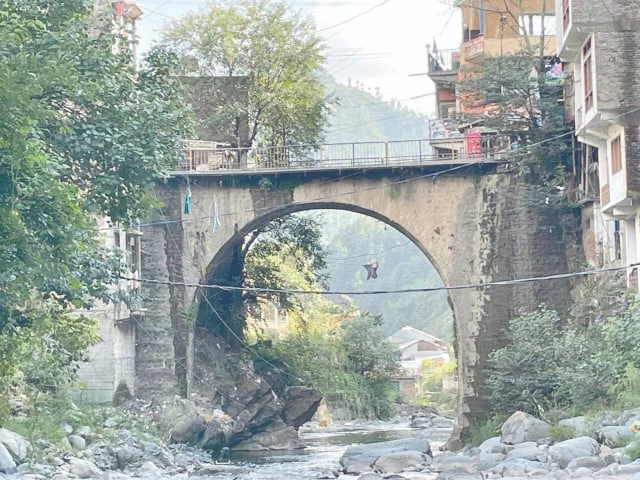
The bridge serves as a primary route connecting Shangla with Lower, Upper Kohistan as well as Gilgit-Baltistan
Central bridge at Alpuri, headquarters of Shangla. Photo: Express
SHANGLA:
The central bridge at Alpuri, the headquarters of Shangla district, has become a major safety hazard, with residents warning that its crumbling condition could trigger a serious accident anytime.
Built in the era of the former state of Swat and later expanded in the 1970s, the bridge was designed to carry only a few hundred vehicles daily. Today, it carries the load of thousands of vehicles, including heavy trucks and oil tankers, far beyond its intended capacity.
Large holes have appeared in the middle and along both sides of the bridge, concrete slabs have broken apart, and visible steel reinforcement is visible in several places. During rain, potholes become even deeper, while damaged guardrails and a weakened structure increase the risk. As a result, heavy vehicles often get stuck, causing hour-long traffic jams and huge problems for local residents, transporters, patients, women, children and travellers.
The bridge now serves as the primary route connecting Shangla with Lower and Upper Kohistan as well as Gilgit-Baltistan. When it was built, the area had a small population and limited traffic, without pressure from three Kohistan districts or the daily influx of vehicles from Gilgit-Baltistan. That reality has changed dramatically, making the bridge a critical but dangerously overstretched lifeline.
Local residents fear that if a large bus or an oil tanker is placed at the center of the bridge, dozens of lives could be lost within moments. They say the responsibility for any such tragedy lies squarely with the administration and elected representatives.
According to sources in the National Highway Authority (NHA), several studies have been carried out for reconstruction and widening over the past several years. Technical teams from Islamabad, Peshawar and Karachi recently visited Alpuri, prepared updated designs and reports and spent significant public funds on documentation and inspections. However, not a single brick has been laid. After each investigation, the files are either shelved or the project is put under political pressure, provoking public anger.
Well-informed NHA sources revealed that the primary hurdle is not technical or financial but political. On both sides of the bridge stand influential multi-storied buildings allegedly owned by individuals associated with the Pakistan Muslim League.
To protect these structures from potential damage during the expansion, the project has reportedly been delayed as part of a vote-for-protection policy that prioritizes private interests over public safety.
During the period of militancy, the bridge was exposed to heavy military traffic, including tanks, and only temporary repairs were carried out. These repairs have since failed, leaving the structure unfit for heavy loads despite the daily passage of thousands of vehicles.
Residents have called on the government, NHA and all political parties to set aside personal and partisan interests and immediately begin the reconstruction of the Alpuri Central Bridge. They warn that if a major tragedy occurs, the blame will lie with an incompetent administration, silent representatives and self-serving politicians.


