
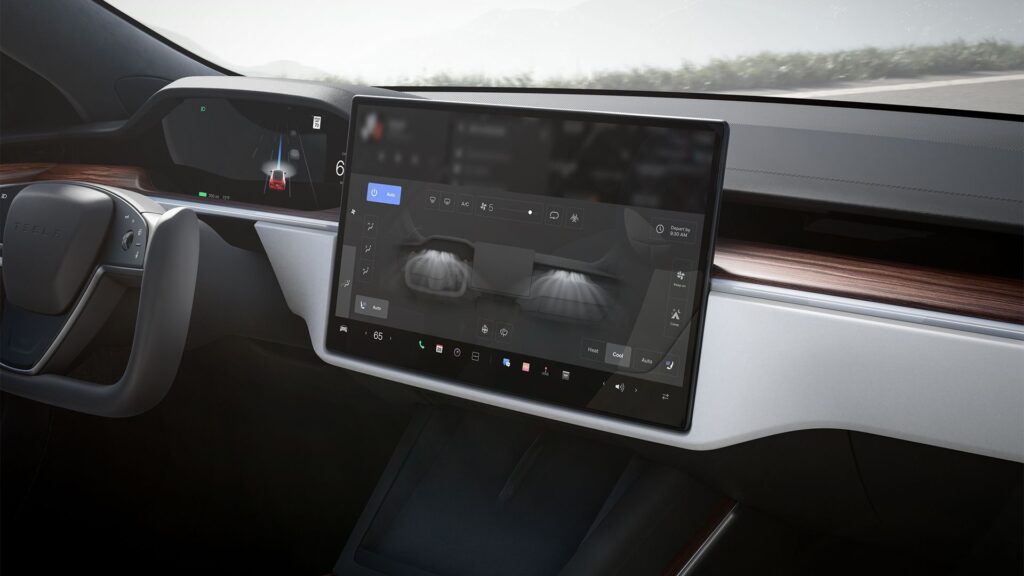
- The Toyota Research Institute study was quite damning
- Trajectory deviation increased dramatically as a result of interacting with the touch screen
- Results suggest that car manufacturers should reduce the amount of menus in cars
The results of a new study from the University of Washington (UW) and the Toyota Research Institute have provided pretty damning evidence against the use of large, distracting touchscreens when driving a vehicle.
In the rather eloquently titled “Touchscreens in Motion: Quantifying the Impact of Cognitive Load on Distracted Drivers,” the study saw 16 participants placed in ultra-realistic high-fidelity driving simulators while researchers tracked eye and hand movements, pupil dilation and skin conductance.
Participants were asked to drive around a typical urban environment and then interact with various side tasks presented on the touchscreen; nothing major, just adjusting the functionality of the car or changing the radio station.
Their ability to both drive and their accuracy when interacting with the touchscreen was measured.
According to Car Scoops, the researchers measured a mix of driver performance metrics and physiological markers, from eye movements, index finger tracking and steering consistency to reaction time and stress signals. This helped them build a better picture of the stress and cognitive load on the human in the driver’s seat.
As you’d expect, the results weren’t pretty for those driving an increased reliance on touchscreens over physical buttons. First, the pointing accuracy of said touch screen and speed of use were reduced by more than 58% compared to non-driving conditions.
Already, this reveals that we humans struggle to physically interact with a touchscreen when we’re busy processing what’s going on out the windshield of a moving vehicle. This then requires the driver to focus more on pressing digital menu screens.
As a result, the study revealed that lane departure increased by over 40% when touchscreen interaction was introduced. Then the vicious circle continues.
Bring back the buttons
We’ve already covered this extensively, but some manufacturers are reintroducing physical buttons for frequently used functions in a vehicle. This is partly a response to consumer backlash, but also because some of the leading safety agencies will penalize automakers for an over-reliance on touchscreens in the future.
I’m a firm believer that things like volume controls, lighting, windshield wipers, and windshield wipers should all be mapped to physical buttons that can be committed to muscle memory after a few uses.
This means drivers don’t have to hunt through often hypersensitive touchscreens to activate very basic functionality. It’s frustrating, but also very dangerous to get stuck in a loop of mis-tapping, fumbling through wrong menus or activating the wrong function.
The research conducted by the University of Washington (UW) and the Toyota Research Institute suggests that automakers are looking to reduce the number of menus required to perform a function, with hard buttons implemented that can be customized to jump to the most frequently used items.
Otherwise, it says, future systems will need to get smarter and adapt when they detect that the driver is becoming more distracted, by enlarging buttons or limiting some functions when it judges that things are getting unsafe.
Unfortunately, it’s simply much cheaper for modern automakers to commit absolutely everything to a touchscreen and then rely on software updates to improve things. Not only are we now faced with completely homogeneous care interiors, but also the prospect of an increasingly button-free future.
Follow TechRadar on Google News and add us as a preferred source to get our expert news, reviews and opinions in your feeds. Be sure to click the Follow button!
And of course you can too follow TechRadar on TikTok for news, reviews, video unboxings, and get regular updates from us on WhatsApp also.


