
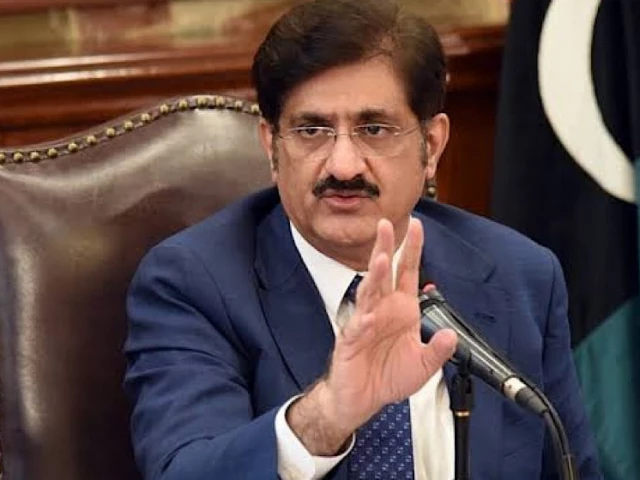
Sindh Chief Minister Murad Ali Shah. PHOTO: Radio Pakistan
KARACHI:
The Sindh Cabinet, headed by Chief Minister Syed Murad Ali Shah, approved a broad set of financial, administrative and policy decisions covering education, culture, security, agriculture, climate action, infrastructure and social protection, while directing all departments to ensure timely execution, transparency and measurable results.
The meeting held at the CM House was attended by provincial ministers, advisers, special assistants, the chief secretary and relevant secretaries.
Presenting the report of the Cabinet Committee on Finance, Minister for Local Government Nasir Hussain Shah briefed the Cabinet on several recommendations. The Cabinet approved a scheme of Rs190,211 million for the construction of a second floor of Girls’ Hostel at NED University of Engineering & Technology, Karachi. The Chief Minister noted that an expansion of student housing was essential to support women’s enrollment in higher education.
For heritage conservation, the Cabinet approved Rs109.5 million – 50 per cent of the total cost – for the conservation and restoration of Saint Saviour’s Church in Sukkur and Saint Thomas Cathedral Church in Hyderabad, with the remaining funds available in the next financial year. “Sindh’s heritage belongs to all communities and must be preserved with care and dignity,” the chief minister said.
The cabinet also approved Rs 30 million for Karachi Literature Festival and Rs 100 million to strengthen Sindh Archives, including publication of rare manuscripts, conservation of old newspapers, digitization of records and establishment of an oral history and archive gallery.
Climate action and carbon financing
In a landmark decision, the Cabinet approved the establishment of the Sindh Climate Change Fund and the Sindh Climate Change Board. The fund will primarily be financed through a corresponding regulatory fee of 12 per cent. on net income from the sale of CO2 credits.
The Cabinet granted the Shaukat Khanum Memorial Trust a one-year exemption from the Infrastructure Cess, recognizing its status as a non-profit cancer hospital and facilitating the import of life-saving medical equipment.


