
- SK Hynix split-cell 5-bit flash increases SSD density without significantly reducing manufacturing complexity
- RAID-0-like parallelism in split-cell NAND dramatically increases read speed
- Each half-cell reduces the supply voltage, which extends the endurance of the five-bit flash
The NAND flash industry continues to search for ways to increase storage density as demand increases from data centers, consumer devices and AI tools.
Conventional scaling through additional 3D NAND layers has become increasingly complex, expensive and difficult to manufacture consistently.
While four-bit QLC flash is already in commercial production, the transition to five-bit PLC flash has remained impractical due to reliability and endurance issues associated with voltage-sensing limits.
How split-cell flash changes the equation
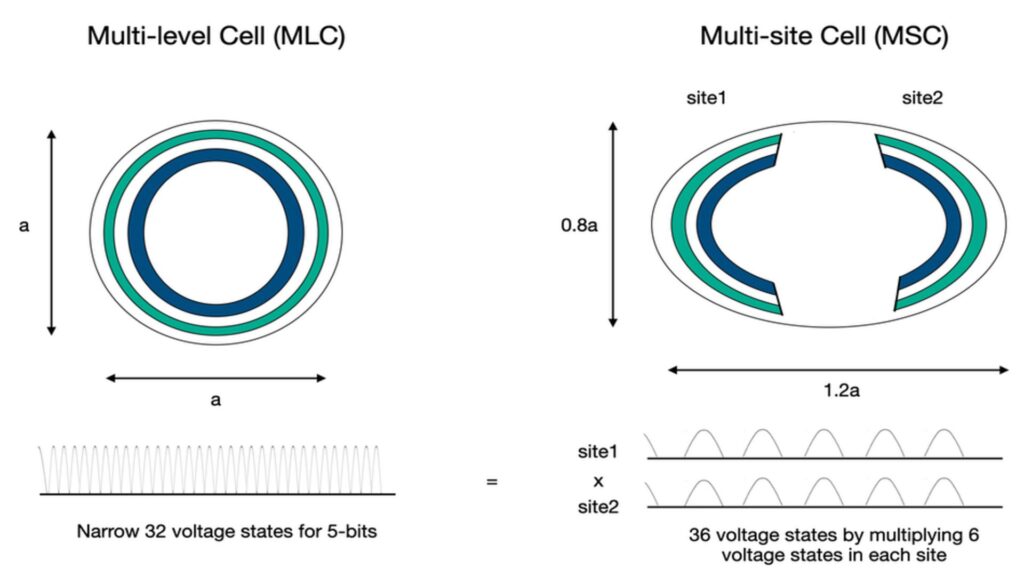
SK Hynix has introduced another approach known as multi-site cell technology. Instead of forcing a single NAND cell to hold all 32 voltage states, the design splits the cell into two independent half-cells.
Each half stores six voltage states, which together represent a five-bit value. This design reduces the amount of tension while maintaining the overall bit density.
The two half-cells work in parallel as a single logical unit, similar to how RAID-0 spreads data across hard drives to increase throughput.
In this case, voltage states are combined during access instead of being striped across separate devices.
The physical cell shape is elliptical rather than circular, allowing for an insulating wall between the halves and separate bit line connections.
SK Hynix says wider voltage gaps within each half-cell reduce electron leakage and shorten programming time.
The two halves are read simultaneously, which the company claims delivers faster read speeds compared to conventional PLC designs.
This method also improves endurance as lower voltage stress reduces wear on the cell.
SK Hynix demonstrated working wafers at the 2025 IEDM conference, signaling that the concept goes beyond simulation.
The split-cell approach requires additional semiconductor process steps, including cell division and hole filling, which adds cost and complexity.
While SK Hynix evaluates manufacturing capabilities, other flash manufacturers, including Samsung, Micron, Kioxia and Sandisk, are expected to study similar ideas.
The concept doesn’t promise cheaper SSDs, just closer ones, and it doesn’t remove the hard drive’s role in large-scale capacity storage.
If manufacturers can produce multi-site cells at scale, PLC flash may finally become viable without the severe drawbacks seen in previous designs.
Via Blocks and files
Follow TechRadar on Google News and add us as a preferred source to get our expert news, reviews and opinions in your feeds. Be sure to click the Follow button!
And of course you can too follow TechRadar on TikTok for news, reviews, video unboxings, and get regular updates from us on WhatsApp also.


