
The anti-graft body tells the court that the investigation against Nawaz, Maryam does not show evidence to support the charges
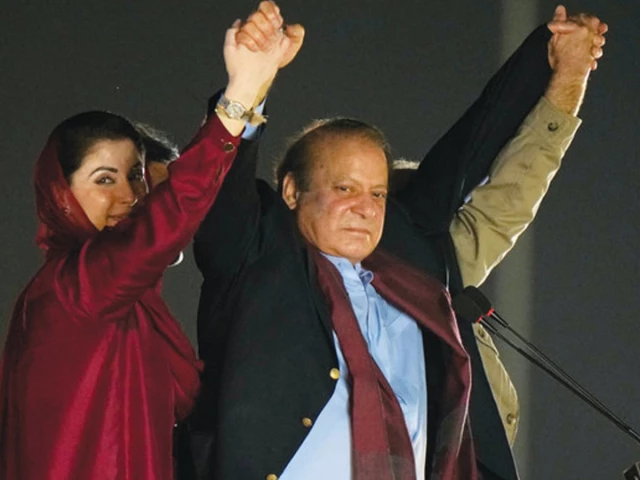
Former Prime Minister Nawaz Sharif and Chief Minister Punjab Maryam Nawaz. Photo: File
LAHORE:
An accountability court on Monday approved the closure of an inquiry by the National Accountability Bureau against former prime minister Nawaz Sharif and Punjab Chief Minister Maryam Nawaz in the Chaudhry Sugar Mills case.
Accountability Judge Rana Muhammad Arif announced the decision while hearing an application filed by NAB seeking formal approval to end the probe.
In its plea, the anti-graft body informed the court that the investigation into allegations of corruption against Nawaz and Maryam had already been completed and no evidence supported the allegations.
The agency asked the court to grant final approval to close the investigation in accordance with statutory requirements, which the court agreed to. During the proceedings, Maryam Nawaz’s lawyer presented arguments in support of the application.
The NAB prosecutor told the court that the investigation into the Chaudhry Sugar Mills case against both executives had already been completed.
The case related to allegations of laundering money and assets beyond known sources of income through alleged irregular business transactions involving the sugar mill, in which Maryam Nawaz had previously been reported to be a major shareholder.
Interestingly, after the liability order, NAB appealed to the Federal Constitutional Court (FCC), asking it to set aside the LHC’s February 4, 2026 order.
NAB initiated an investigation against Chaudhry Sugar Mills on 14 November 2018. During the investigation, Maryam Nawaz, now serving as Punjab Chief Minister, was arrested on 8 August 2019 and placed in physical custody for 48 days.
She subsequently filed a post-arrest bail application with the LHC. On 31 October 2019, the court granted her bail against two sureties of Rs 10 million each and directed her to deposit Rs 70 million and submit her passport to the registrar.
NAB challenged the grant of bail before the Supreme Court, but the petition was dismissed on 22 August 2023 after it was withdrawn. Following amendments to the NAB Act, the NAB investigation officer concluded that no case of corruption or corrupt practices was established.
Based on this conclusion, on 3 April 2024, the NAB Executive decided to withdraw the case under Section 31B(1) of the NAB Order.
After the conclusion of the proceedings, Maryam filed a miscellaneous application with the LHC demanding the refund of the Rs70 million deposited as part of her bail conditions.
The LHC ruled on 4 February 2024 that the case could only be formally concluded with the approval of the accountability court and directed the accountability court in Lahore to decide the case within a month.
In its appeal, NAB argues that when the chairman of NAB approved the withdrawal of the investigation, the high court had no authority to interpret the law in a way that mandated further legal approval.
It argues that when a case is withdrawn at the investigation stage, the accountability court does not have legal authority over the case. It says that if the law does not require a court approval to withdraw an investigation, such a requirement cannot be introduced through a court order.
NAB further claims that the LHC issued its decision on February 4 without notifying the Attorney General’s Office and that the court exceeded its jurisdiction by taking cognizance of the case. It is asking the FCC to declare the February 4 ruling null and void.
(With input from JEHANZEB ABBASI FROM ISLAMABAD)


