
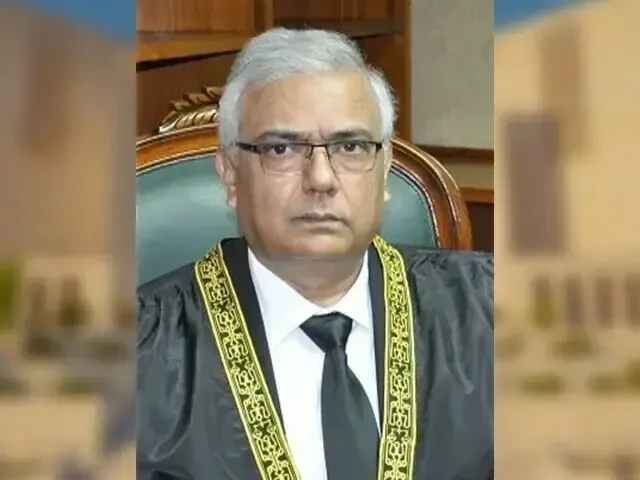
Justice Aminuddin Khan. PHOTO: FILE
ISLAMABAD:
The Federal Constitutional Court upheld the validity of the super tax on Tuesday, ruling that Section 4B of the Income Tax Ordinance 2015 remains in force.
FFC Chief Justice Aminuddin Khan read the judgment and noted that the detailed judgment will be issued later, rejecting objections that the case was not maintainable. The court also confirmed that Parliament has the power to levy taxes through legislation.
The FCC rejected all petitions challenging the super tax. The court ruled that oil and gas sector companies should approach the relevant tax commissioner individually to obtain any exemptions.
The court overturned Supreme Court decisions that had declared the super tax discriminatory and confirmed that the legislation is legally valid. The court clarified that Sections 4B and 4C, which govern the imposition of the super tax, are fully in accordance with the law.
It also specified that the tax will not apply to mudarabah, unit trusts or unit trusts.
The super tax was first introduced in 2015 in Khyber-Pakhtunkhwa to finance the rehabilitation of terror victims. At that time, an additional 5% super tax was levied on those earning annual profits above Rs 300 million. All high courts had upheld its implementation.
In 2022, the super tax was applied to people earning over Rs 150 million annually, at a maximum rate of 10 per cent. Various traders, banks and companies challenged the tax in the high courts, arguing against its retroactive effect and the risk of double taxation.
The FCC has held 17 hearings on the matter. The case was first heard in the Supreme Court in 2019 during the tenure of former President Umar Ata Bandial.
After the 26th constitutional amendment, the case was transferred to a constitutional court, which continued to hear the case. After the 27th constitutional amendment, the case was moved to the Federal Constitutional Court.
Read: The court adjourns the super tax hearing on January 12
Representatives who appeared included Revenue Ministry’s Hafiz Ihsan Khokhar, Karachi Commissioner’s Dr. Shah Nawaz and Lahore Commissioner Asma Hamid.
Khokar told the media that the verdict will bring Rs310 billion to the federal government. “The Federal Constitutional Court has recognized Parliament’s power to legislate,” he said, adding that the High Courts had previously exceeded their powers.
Khokhar also noted that the court confirmed that there had been no discriminatory treatment through the super tax.
Super dear
The super tax is an additional tax on high-earning individuals, companies and industries, mainly targeting large companies. In the 2022-23 federal budget, the government imposed up to 10% super tax on major sectors including cement, steel, sugar, oil and gas, fertilisers, banks, textiles and others, citing the need to raise additional revenue for economic stabilisation.
Read more: Super tax amount clearly defined, companies must pay: SC
Petitions were filed in the Supreme Court by individuals and organizations challenging the super tax introduced by the PML-N government in 2015 to provide funds to people displaced by Operation Zarb-e-Azb.
Earlier last year, the Supreme Court questioned whether the federal government could distribute super tax revenue to provinces. Lawyers argued that the levy, introduced in 2016 to fund displaced persons, has since been extended, but no funds have been used for the stated purpose.


