
The KP CM demanded the federal government fulfill its promise to fund the Chashma Right Bank Canal
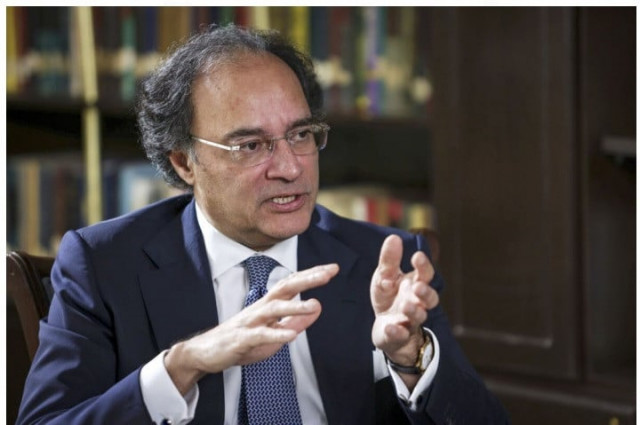
Union Minister for Finance and Revenue Muhammad Aurangzeb. PHOTO: APP
ISLAMABAD:
Khyber-Pakhtunkhwa (KP) Chief Minister Sohail Afridi has announced that he will attend the maiden meeting of the National Finance Commission (NFC), but demanded that the Center clear over Rs3 trillion of outstanding liabilities and also honor its commitment to build an irrigation canal.
“I will attend the NFC meeting as it is a matter of fiscal rights of the province,” Afridi said while talking to reporters in Islamabad on Friday.
The federal government has called the maiden meeting of the NFC on December 4 in Islamabad. This meeting will form the basis for devising a new formula for the distribution of fiscal resources between the Center and the federating units.
At the maiden meeting, the commission will have general discussion of the strategy for discussions on the 11th NFC Award, including proposed formation of sub-groups for discussions on the thematic areas, according to the agenda of the meeting.
Finance Minister Muhammad Aurangzeb will chair the meeting, which will be attended by four provincial finance ministers and their technical members.
The finance ministers’ portfolios are held by KP CM Afridi and Sindh CM Syed Murad Ali Shah.
The five key stakeholders, Balochistan, Punjab, KP, Sindh and the Federal Government will make presentations on their respective fiscal positions.
The federal government wants to reduce the share of the provinces from the existing 57.5% of the total divisible pool, either by cutting the percentage of revenue or by shifting responsibility for expenditure or through a combination of both.
However, the provincial share from the current 57.5% cannot be reduced until the constitution is amended. Prime Minister Shehbaz Sharif has recently shared his thoughts on reducing the provincial share.
During a high-level meeting, Shehbaz stated that customs duties were not part of the NFC award and should be treated as federal revenue.
However, the 7th NFC, which was finalized and approved in 2009-10, includes the customs duties as part of the federal divisible pool along with income tax, wealth tax, capital gains tax, sales tax and federal excise duty.
For the current fiscal year, the provincial governments’ estimated share in federal taxes is Rs8.2 trillion on the basis of Rs14.13 trillion tax collection by the Federal Board of Revenue. Out of this amount, Rs 892 billion or 10.8% is due to customs duties.
The KP Chief Minister said that due to revenue generation, reverse population density and increase in population ratio after the merger of the erstwhile tribal districts, his province’s share should be increased in the next NFC award.
He said the federal government owed Rs 3 trillion. to the province on account of net hydel profit and pending share under NFC.
The federal government owed Rs 2.2 trillion due to outstanding dues of net Hydel profit and another Rs 800 billion is outstanding under NFC, he said.
The federal government had committed to provide Rs700 billion, Rs100 billion a year, in costs to reintegrate and develop the merged districts, said Muzammil Aslam, financial adviser to the KP CM. Aslam said so far only Rs165 billion has been given over the past seven years, leaving a gap of Rs535 billion.
The provincial population has increased, which should have increased our share to 19.6% seven years ago, but despite that, the federal government owes the province Rs700 billion to Rs800 billion, he said.
This year, the provincial share in NFC based on the revised population is Rs225 billion higher than what it has received so far, Aslam said.
For this financial year, the federal government had committed Rs65 billion to the merged districts, but KP did not receive a penny during the first five months of this financial year.
The KP CM also demanded that the federal government fulfill its promise to fund the Chashma Right Bank Canal, which, he said, was very critical for food security in the province. He said the Center had initially committed to provide 80% funding for the project, which it has now reduced to 65%.
We have allocated 35% of our funding share but the federal government is not fulfilling its commitment, Afridi said.
He said the Punjab government’s decision to ban the transportation of wheat to his province pushed the price of wheat and bread high and created very negative sentiments in the province.
The upcoming NFC discussions are based on the idea that the federal fiscal problems are rooted in the 7th NFC, which increased the provincial share by 10%.
However, the 10% increase in the share had to be offset by a 1% increase in tax to GDP every year from 2010. In the year 2010, the tax to GDP ratio was 10%, which remained stuck there.
“Pakistan’s tax-to-GDP remains stubbornly low at around 10% of GDP over the past 5 years,” said the IMF’s Governance and Corruption Diagnostic Assessment report, released on November 9 by the Ministry of Finance.
The IMF report emphasized that Pakistan’s tax system is also complicated by the lack of harmonization and coordination between federal and provincial taxes.
The lack of harmonization and coordination of the sales tax, with the federal goods tax and the provincial taxes on services, continues to complicate the tax system, according to the new report.
The IMF said the uncertainty and disparate treatment lead to disputes that can be resolved through negotiations with tax authorities, creating opportunities for corruption.
It added that the National Tax Council continues to work on harmonization with assistance from the World Bank, but progress is slow.
The IMF report emphasized that the tax-related concerns are exacerbated by the lack of a clear and coherent medium-term strategy for the design of tax policy. The absence of such a strategy leads to an ad hoc short-term approach to tax policy formulation.
While authorities may set a short- or medium-term tax-to-GDP target, there is no coherent 3- to 5-year tax reform strategy that seeks to meet the usual tax reform goals of making the system more efficient, fairer and simpler, while raising revenue, the IMF said.
It added that the tax system in Pakistan is overly complex, creating uncertainty for taxpayers, inviting disputes, enabling corruption and compromising economic efficiency and fairness.
This complexity leads to uncertainty for taxpayers and the FBR, but also provides opportunities for tax planning and tax evasion.
“Disputes are often resolved through negotiations with FBR officers,” the IMF said. These negotiated settlements increase corruption risks and also lead to potential inequities due to the likely difference in treatment between taxpayers, it added.


