
Prime Minister announces Rs80 Rs129b petrol price cut deployed to cushion inflation shock. The aid package’s goals for commuting
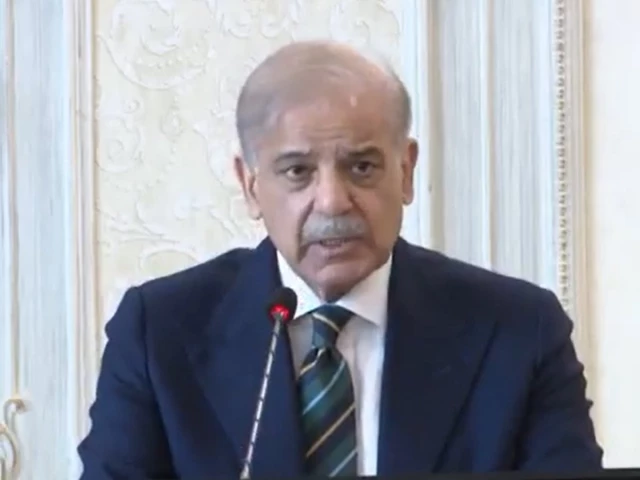
Prime Minister Shehbaz Sharif. SCREEN GRAB
ISLAMABAD:
In a surprise announcement, Prime Minister Shehbaz Sharif on Friday ordered an immediate reduction of Rs80 per liter in oil tax, bringing petrol prices down from Rs458 to Rs378 per liter for a month, along with a comprehensive relief package that includes targeted subsidies for transport, farmers and low-income consumers on world oil prices.
The new price comes into effect at 12 noon on Saturday.
Unveiling the package, the prime minister said the move was aimed at protecting the public from the burden of rising fuel costs triggered by the ongoing conflict in the Gulf region.
In addition to the price reduction, motorcyclists receive a subsidy of DKK 100 per litres, while freight transport, public transport and goods wagons also receive a subsidy of DKK 100 per liters for a month.
Under the relief measures, small trucks will receive Rs70,000 per month, large trucks Rs80,000 and public transport buses Rs100,000 as monthly subsidies.
The Prime Minister said the aim was to ensure the cost of essential goods and transport fares did not translate into further financial pressure on the public.
He also announced support for small farmers who will be provided Rs1,500 per hectare in assistance.
As a further relief measure, the government has decided not to increase fares for economy class passengers on Pakistan Railways, with clear directives issued to the Ministry of Railways in this regard.
In addition, the prime minister announced that members of the federal cabinet would pay six months’ salary into the national treasury.
In the broader economic context, the Prime Minister said the ongoing war in the Gulf had driven oil prices to unprecedented levels, which had also severely affected Pakistan.
He said the situation was a “harsh reality” where “the poor stove is dimming”, farmers are facing enormous difficulties and new challenges are emerging for ordinary citizens.
He said the government had made every effort to use national resources to reduce public problems and protect citizens from an “inflationary storm”.
In the last three weeks alone, he said, Rs129 billion had been spent from national resources to prevent the full impact of rising oil prices from reaching the public.
The Prime Minister noted that even major global economies were struggling under inflationary pressures, while Pakistan was also significantly affected.
He stressed that it was “inappropriate” to transfer the full burden of recent oil price increases to the public.
Highlighting the consultative process behind the measures, he said the relief package was finalized after extensive deliberations, including a national hearing held by the President, attended by provincial chief ministers, the Prime Minister of Azad Kashmir, the Interim Chief Minister of Gilgit-Baltistan and other senior leaders, including the Deputy Prime Minister and Chief of Army Defenshalse Force, Mundshaffen Staff and Chief of Army Staff.
He expressed gratitude to the provincial chief ministers – Maryam Nawaz, Murad Ali Shah, Sohail Afridi and Mir Sarfraz Bugti – for allocating provincial resources to support the national effort.
He said all measures would also apply to Gilgit-Baltistan and Azad Kashmir where the federal government bears the financial cost.
Referring to global disruptions, he said long queues and severe shortages had occurred in several countries, but Pakistan had managed to avoid such crises through timely decisions and coordinated efforts.
The prime minister reaffirmed the government’s commitment to public welfare and stated that efforts will continue until citizens are able to return to normal life with “peace and comfort”.
He added that the government would use all available resources to ease public problems during this critical period.
In a related development, the government issued a notification announcing a reduction in Petroleum Development Levy (PDL) on petrol, bringing it down to Rs 80 per liter as part of its wider fuel relief measures.
According to the notification, the tax on petrol has been cut to Rs 80 per litre. The revised rates also set the PDL on high-octane blend component (HOBC) at Rs 305.37. per litre, kerosene at Rs 20.36. per litre, light diesel at Rs 55.84.
Meanwhile, oil development tax on high-speed diesel has been zeroed.


