
Former US ambassador warns conflict exacerbates humanitarian crisis and signals growing US isolation
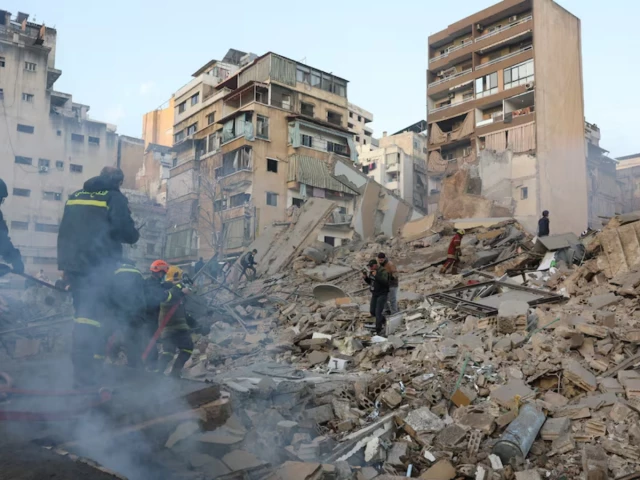
Emergency personnel work at the site of a collapsed building in the wake of an Israeli attack in central Beirut’s Bachoura neighborhood, following an escalation between Hezbollah and Israel amid the US-Israel conflict with Iran, Lebanon March 18, 2026 PHOTO: REUTERS
Ambassador Masood Khan, former president of Azad Jammu and Kashmir and former ambassador of Pakistan to the United States, has said that the ongoing conflict involving Iran has exposed deep fissures in the global order, highlighting strategic miscalculations, dire humanitarian consequences and the growing isolation of the United States on the international stage.
In a televised analysis, Ambassador Khan noted that recent military attacks have caused extensive damage across Iran, targeting military personnel, strategic installations and civilian infrastructure, resulting in a severe humanitarian crisis with heavy civilian casualties, including women and children.
He described the conflict as an asymmetric war, with Iran utilizing ballistic missiles, drones and other strategic capabilities to counter conventional military superiority.
Read: US troops told Iran war is ‘God’s plan’ to trigger Armageddon
The war between Iran and the US-Israeli alliance began on February 28, 2026, when coordinated airstrikes targeted Iranian military sites citing threats to regional security. The conflict escalated sharply after the assassination of Iran’s Supreme Leader, Ali Khamenei.
The Iran conflict has resulted in heavy losses throughout the region. In Iran, at least 1,270 people have been killed, including 175 schoolgirls and workers in Minab, while Lebanon has reported 594 deaths from Israeli airstrikes, including 84 children. Iraq, Syria, the UAE, Saudi Arabia, Bahrain, Kuwait and Oman have also suffered casualties, with dozens killed in missile and airstrikes. The US has reported around 140 soldiers wounded, mostly minor injuries, while Israel has lost at least 12 civilians and several soldiers, highlighting the extensive human cost of the ongoing conflict.
Despite the massive use of air power by the US and Israel, Iran has maintained its defensive posture and its new leadership has vowed to continue the conflict, even threatening to block the strategic Strait of Hormuz. The war has driven oil and energy prices higher and poses serious geopolitical and economic challenges to neighboring countries, especially Pakistan, which shares a 900km border with Iran and has deep cultural, religious and political ties to its neighbour.
Discussing the political dimensions, he observed that US decision-making seemed heavily influenced by strategic alignments, particularly with Israel, and lacked broad international support. Recalling the 2015 nuclear deal as a framework for diplomacy, Ambassador Khan noted that the US withdrawal undermined progress and contributed to the current escalation.
He also highlighted how the conflict has diverted global attention from crises in Gaza and the Occupied Palestinian Territories, pointing out that the selective application of international law continues to erode global trust. The former envoy warned of pressure on traditional alliances, with several European nations showing reluctance to support recent military actions, reinforcing perceptions of US isolation despite its global power.
Read more: 200 American soldiers were wounded in seven countries during the Iran war
The humanitarian situation in Gaza and the Occupied Palestinian Territories remains dire, with civilians bearing the brunt of Israel’s ongoing airstrikes, military operations and expansion of illegal settlements.
These actions have exacerbated food and medical shortages, while hospitals and schools struggle to function amid damaged infrastructure. International observers warn that the protracted crisis risks a full-scale humanitarian disaster as civilians face displacement, limited access to essential services and increasing insecurity, underscoring the urgent need for sustained diplomacy and international aid interventions.
On the economic front, Ambassador Khan emphasized disruptions in global energy markets and the emergence of alternative financial systems that could challenge the US dollar, warning that prolonged instability could have far-reaching consequences for global trade and economic stability.
He concluded by calling for renewed diplomacy, adherence to international law and a balanced approach to conflict resolution. “Sustainable peace cannot be achieved through force alone,” he said. “It requires dialogue, restraint and a commitment to justice and multilateralism.”


