
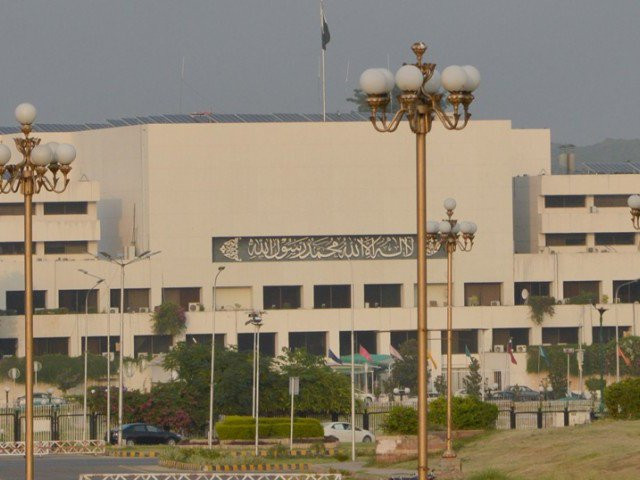
The joint meeting approves body as the EU links GSP-Plus access to strengthened HR security
ISLAMABAD:
Pakistan on Tuesday approved a law to set up the National Commission for Minority Rights, giving it sweeping powers to call people as witnesses, give their statements under oath and seek the support of the higher judiciary to grant minorities their rights.
A joint session of Parliament approved the law as part of the European Union’s (EU) conditions for the continuation of duty-free access for Pakistani goods to the markets of the 27-nation bloc. The joint session passed the law by a 160-79 majority just a day before the EU’s GSP-Plus monitoring mission’s initial recommendations to the government.
Law Minister Azam Nazeer Tarar tabled the bill amid strong opposition from Jamiat Ulema-e-Islam-Fazl (JUI-F) and Pakistan Tehreek-Insaf (PTI). The PTI tried to link the issue with religion, which Law Minister Tarar and Deputy Prime Minister Ishaq Dar strongly objected to.
“The opposition tried to give a wrong color to the bill,” Dar said while condemning the opposition lawmakers for using religion for the political gains. Tarar clarified that “neither the law and the constitution nor our conscience allows us to make a proposal that is contrary to the Qur’an and the Sunnah”.
Parliament passes the law at a time when an EU delegation led by Sergio Balibrea, Adviser, Directorate General for Trade, is visiting Pakistan. The mission will submit its report in February next year, and this will also form the basis of the new GSP-Plus scheme.
Pakistan’s exports are nose-diving again, down 6.4% in just five months of this financial year. The country’s stability in the external sector depends on the continuation of GSP-Plus duty-free access to European markets, which helps offset the inefficiency and high cost of Pakistani goods.
The visiting EU delegation had expressed its concerns about the state of minority rights, human rights and freedom of expression, according to the officials involved in these discussions.
The Law Minister clarified that non-Muslims are defined in the constitution and there is no change in the definition of non-Muslims. “This is a commission for non-Muslims. Our Hindu, Christian and Parsi brothers are as good Pakistanis as we are,” he added. The minister recalled that a Supreme Court judgment from 2014 called for the establishment of a commission for minorities.
The president had previously returned the bill due to objections to the definitions of human rights, minorities, lack of clarity on the appointment of the chairman of the commission and administrative and financial powers. The minister said that all the objections of the President have been addressed in the revised legislation.
According to the bill, the provisions of this Act have effect regardless of anything that is in conflict with any other law in force for the time being. Human rights have been defined as citizens’ rights to life, liberty and dignity that are guaranteed and included in international instruments, including political rights and women’s rights.
Minorities shall have the same meaning as defined in Article 260 of the Constitution, and minority rights shall include human rights in general, special guarantees and protections provided by law, and all affirmative measures and political incentives for minorities that may be exercised individually and collectively.
The chairman of the commission will be appointed for four years and this person must be a citizen of Pakistan who is not below 35 years of age. The Secretariat of the National Assembly will within 60 days begin and complete the process for the appointment of the chairman of the commission.
Powers
The Commission will have the power to assess and monitor the implementation of the constitutional guarantees and ensure the promotion and protection of minority rights. It will examine and review existing or proposed policies or programs, action plans, legislation, rules, regulations, administrative instruments or other positive measures.
It will recommend changes, give advice or propose proposals for the prevention of discrimination and the protection of minority rights to the authorities concerned.
The Commission will investigate the application of international minority rights, agreements and conventions and deliver to the government reports, proposals or recommendations necessary for the effective application of such rights or agreements and conventions.
The Commission may take suo moto or on a petition presented to it by a victim or any person on his behalf, inquire into complaints of any violation of the rights of minorities or support or abetment thereof by any organization, public or private, or any body, department, authority or instrumentality of a federal, provincial or local government.
It may take suo moto of any neglect or willful violation of any provision of law in the prevention of or fair and independent inquiry or investigation of such violation by any person or authority and will monitor the implementation status of minority rights, judgments and, where necessary, seek guidance on leniency and support from higher judiciary to effectively deal with any bottlenecks.
The Commission may submit special reports to Parliament through the Government on any issue relating to minorities and in particular the challenges they face.
It will participate in international forums and interact with human rights experts across the globe; take special measures for integration of all groups among minorities including Dalit and Scheduled Caste to promote solidarity and eliminate racial discrimination and recommend policy measures for social emancipation under the Act.
The Commission shall have full power to create new posts and abolish old posts. It will have full power to transfer funds from one account item to another account item and to sanction expenditure on any item within the allocated budget.
Inquiry about complaints
The commission, while investigating complaints of violations of minority rights, may, by law, call for information or reports from the government or any other authority or organization.
The Commission, while investigating complaints, has all the powers of a civil court, hearing a case under the Code of Civil Procedure, 1908, as regards summoning and enforcing the attendance of witnesses and examining them on oath; requires discovery and production of documents as required by law.
The Commission will receive evidence of declarations; subpoena any public record or copy from any court or office; and issue commissions for questioning witnesses or documents.
The commission shall have the power to require any person, subject to any privilege that such person may claim, to give information about such points or matters as the commission may, in the opinion of the commission, be useful to or relevant to the subject matter of the investigation, the Act states.
Where the investigation reveals violations of minority rights or negligence in preventing a public employee’s violation of minority rights; it may recommend to the government or authority concerned the initiation of prosecution or such other action as the commission deems appropriate against the persons concerned.
It may recommend to the Government or authority concerned to grant such immediate interim relief to the victim or his family members as the commission may deem necessary. The commission may recommend any disciplinary action to the competent authority against any person or employee for failure to comply with the order of the commission.


