
- Memory bandwidth defines real performance for professionals handling intensive workloads
- Future M5 Pro and M5 Max chips could double the throughput for creative professionals
- An extra 275 GB/s of bandwidth could save professionals both time and money
For professional users, one metric often defines whether a chip really meets the requirements of their work: memory bandwidth.
Apple’s recently announced M5 is the basis for a new 14-inch MacBook Pro and iPad Pro (and an updated Apple Vision Pro), and as part of my series on Apple’s silicon, I thought it might be interesting to take a look into a possible future.
Apple hasn’t announced or even hinted at M5 Pro and M5 Max variants of its new chip, and if they do arrive, it likely won’t be for a good year or so. Still, it’s possible to take some educated guesses about what these versions can offer professionals.
Inside Apple silicon: Part four of a five-part series on the M-class processors
This article is the fourth in a five-part series that takes a deep dive into Apple’s M-class processors, from the early M1 to the recently announced M5 and our expected M5 Ultra. Each piece will examine how Apple’s silicon has evolved in architecture, performance and design philosophy, and what those changes could mean for the company’s future hardware.
M5 Pro and Max
We asked Google Gemini to look at Apple’s previous M chips and model what we could expect from an M5 Pro and M5 Max.
Its predictions suggest that the same core architecture can scale up sharply in throughput, a factor that shapes performance in ways that raw CPU or GPU numbers often fail to capture.
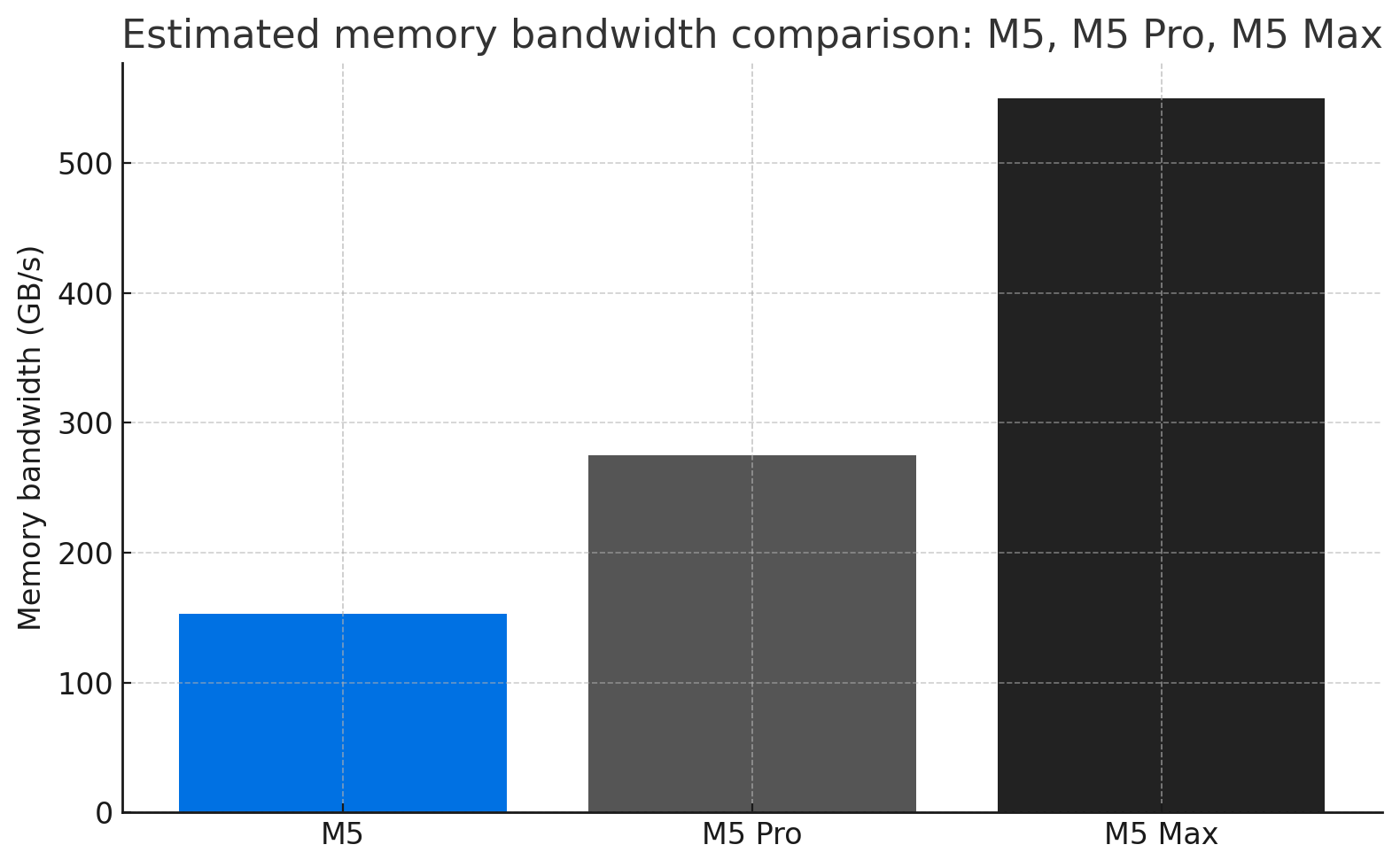
The base M5 already raises total memory bandwidth to 153 GB/s, almost 30 percent over its predecessor. For most users, this jump provides faster app response and smoother multitasking.
For workloads driven by data movement, such as editing multi-stream 8K footage, training small AI models, or rendering in high-resolution 3D, this number is far more than a specification.
It defines how efficiently the processor feeds data to its computing devices without waiting for memory.
Gemini’s modeling points to an M5 Pro running at around 275GB/s and an M5 Max potentially doubling that number to 550GB/s.
While these chips obviously don’t exist yet, the projections illustrate Apple’s likely path for professional-grade performance.
The M5 Max would essentially double the width of its memory interface, allowing apps that rely on real-time asset loading or large tensor operations to run at full speed without cache bottlenecks.
The extra bandwidth could translate directly into saved time on renders and exports to video editors and shorten training runs and make larger on-device models practical for AI developers, reducing reliance on cloud compute.
Over months of production, this time savings and avoided cloud costs can potentially add up.
This focus on throughput rather than maximum clock speed reflects a broader trend in chip design.
As computing devices become more capable, memory systems must scale in parallel to prevent underutilization.
Assuming it follows this pattern, the M5 Max would not only be faster, but also more efficient at sustaining peak loads over longer sessions.
If these projections hold, Apple’s next professional tier could deliver a tangible benefit to users who rely on continuous, high-bandwidth processing.
In professional computing, memory speed remains the silent measure that defines real-world performance.
Follow TechRadar on Google News and add us as a preferred source to get our expert news, reviews and opinions in your feeds. Be sure to click the Follow button!
And of course you can too follow TechRadar on TikTok for news, reviews, video unboxings, and get regular updates from us on WhatsApp also.


