
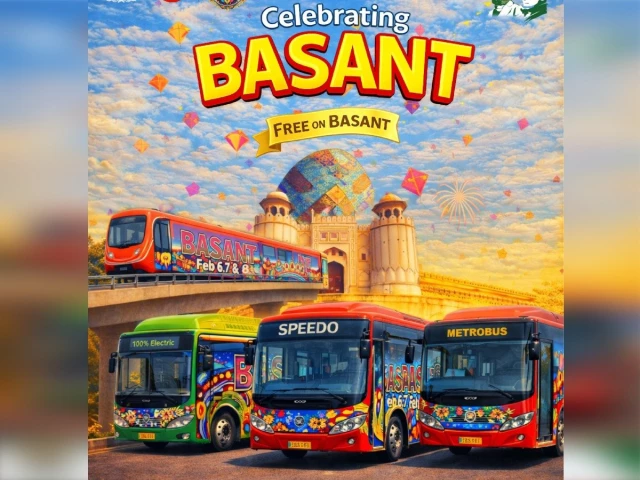
Expressing satisfaction, Provincial Transport Minister Bilal Akbar says citizens will enjoy free travel without worry
The Punjab government on Saturday announced that it would provide free public transport facilities during the upcoming Basant festival as part of a special initiative with the Punjab Masstransit Authority (PMA) finalizing its plan.
“As part of the Basant celebrations from February 6-8, free public transport facilities will be available in Lahore as per the directions of CM Punjab Maryam Nawaz Sharif. This initiative aims to facilitate citizens, promote safe mobility and ensure smooth movement through the city during the festive days,” Punjab Masstransit Authority said in a statement.
The move follows the Punjab government’s decision to grant special permission for Basant celebrations from February 6 to 8, restricting the festival exclusively to Lahore under a comprehensive set of legal, administrative and security measures aimed at preventing the fatalities that had previously prompted its ban.
As part of Basant celebrations from 6th of February to 6th of February, public transport facilities will be available in Lahori in accordance with the 𝐝𝐢𝐫𝐞𝐜𝐝 𝐨𝐟 𝐂𝐌 𝐏𝐮𝐧𝐬𝐛… pic.twitter.com/ozWIdHDhbb
— Punjab Masstransit Authority (@Masstransit_PMA) 28 January 2026
The statement added that from 6-8 From February, commuters will be able to travel for free on Metro Bus Service, Orange Line Metro Train, Speedo buses and electric buses across Lahore. The Orange Line Metro Train will offer free travel from Dera Gujran to Ali Town, benefiting around 270,000 passengers daily, authorities said.
A total of 64 metro buses will run between Shahdara and Gajjumata, enabling approximately 150,000 passengers per day to travel free of charge.
For Lahore’s feeder routes, 188 buses will run across 21 routes, while under the Punjab Mass Transit Authority, 40 electric buses will provide free services on two routes in the city. Overall, around 600,000 passengers are expected to benefit from the free travel facility every day.
Meanwhile, Provincial Minister for Transport and Mass Transit Bilal Akbar Khan expressed satisfaction with the arrangements and said, “At Basant, citizens will be able to avail free travel facilities without any worry.”
Read more: Basant is coming back but not like before
After years of silence in Lahore’s winter skies, Basant is poised to return, cautiously and tightly regulated, as the Punjab government prepares to revive a festival once synonymous with colour, rooftops and spring renewal, yet long overshadowed by tragedy and controversy.
Basant, traditionally observed on the fifth day of the month of Magh in late January or early February, marks the arrival of spring and has historically been celebrated across Punjab, including in India and among Punjabi diaspora communities, with kite flying at the heart of the festivities.
In Pakistan’s Punjab, however, the festival gained a darker reputation in the early 2000s, when celebratory gunfire, glass-covered strings, metallic wires and roof accidents resulted in several deaths, prompting authorities to impose a blanket ban in 2007.
Read also: Punjab bans kites with religious, political images in front of Basant
This year’s revival follows the promulgation of the Punjab Kite Flying Ordinance 2025, which formally reopened the door to Basant, while placing unprecedented restrictions on all aspects of the festival, from kite dimensions and string material to sound systems and rooftop access.
According to official notifications issued by the Lahore district administration following instructions from CM Maryam, kite flying will be allowed only within Lahore district limits and only during the three designated days, while enforcement elsewhere in Punjab will remain absolute.
The rules impose a complete ban on nylon, plastic, chemical-coated and glass-coated strings, metallic thread and bobbins, and only allow cotton strings wound into round ‘pinna’ shapes, each bearing a QR code to ensure traceability and regulatory oversight.
Strict restrictions have also been placed on kite sizes, with ‘patang’ and ‘guda’ dimensions clearly defined, and offenses punishable under the Punjab Regulation of Kite Flying Ordinance, with jail terms of up to five years and fines of Rs2 million.


