
.
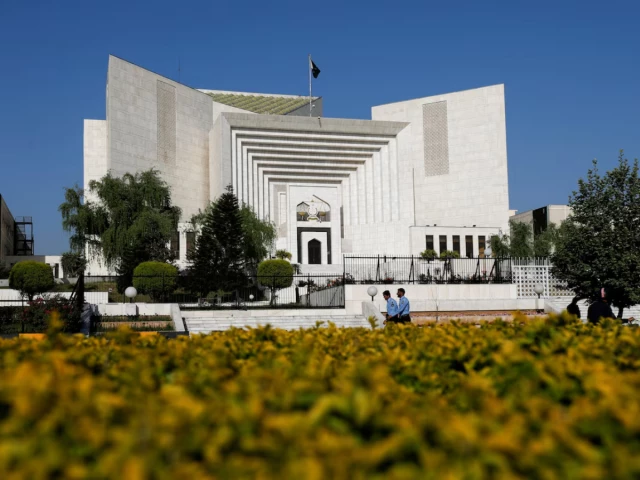
Police officers walk past the Supreme Court of Pakistan building in Islamabad, Pakistan April 6, 2022. REUTERS
ISLAMABAD:
The Federal Constitutional Court (FCC) has made it clear that the Supreme Court’s power to strike down legislation on constitutional grounds is no longer vested in it under the current constitutional arrangement.
“The Constitutional Amendment (Twenty-seventh) Act 2025 has restructured the constitutional distribution of judicial power. As a consequence, the jurisdiction of the Supreme Court has been correspondingly curtailed in this respect and the power to strike down legislation on constitutional grounds is no longer vested in it under the current constitutional arrangement,” the current constitutional arrangement says.
The court found that the Khyber-Pakhtunkhwa Sales Tax on Services Act, 2022 is not ultra vires the Constitution. In its nine-page judgment in the case, authored by Justice Aamer Farooq, the court notes that although tax referrals are not expressly enumerated within “our jurisdiction under the Constitution”, the omission does not remove the JFC from jurisdiction in the case.
“This is so because Tax Reference No. 18 of 2023 raises a significant question of constitutional interpretation,” the judgment said, adding that the Supreme Court of Pakistan does not exercise any jurisdiction in cases requiring inquiry into the vires of the law.
The FCC held that Article 175E(5) authorizes it to call for the registration of “any matter” and the invocation of “that provision itself gives this court jurisdiction to decide a matter where it might otherwise lack express jurisdiction”.
“Conversely, since this Court is the ultimate forum for determining the vires of legislation, it has jurisdiction to hear cases, even in the absence of express jurisdiction, provided there is a substantial question of constitutional interpretation. In the instant case, such a question clearly arises in the form of a challenge to the vires of the challenged statute.”
The judgment said that a collective and harmonious reading of the constitutional scheme governing both Courts establishes that “this Court is the only apex forum competent to decide questions… of law on the interpretation of the Constitution, including vires of legislation”.
“While such jurisdiction may have been previously exercised by the Supreme Court under an earlier constitutional framework, under the present constitutional arrangement that authority is vested exclusively in this Court (FCC),” the ruling added.
“Article 175E(5) provides that the Federal Constitutional Court ‘may’ require the admission of a case, thereby conferring a discretionary but constitutionally structured power on that court. The discretion is further extended by the introductory words which allow this court to act either on its own motion or otherwise, meaning that the jurisdiction may be submitted before or after a case is heard.”
But, the judgment continued, this power is not unstructured, for the provision itself limits its exercise to a substantive condition, namely that the case must involve a “substantial question of law on the interpretation of the Constitution.
“Although we do not exhaustively delineate the contours of when such a question arises, it is obvious that a challenge to a statute’s vires inherently raises a substantial question of constitutional interpretation, since the invalidation of legislation can rest only on its inconsistency with a constitutional provision or command.”
The judgment said the provision empowers the court to demand record of “any proceedings”. Language that is unqualified and admits of no distinction as to the nature, form or classification of cases thereby includes cases of every description, including, but not limited to, tax references.
“The breadth of this authority is further enhanced by the phrase ‘any court’ from which the suit may be called. The Constitution neither defines nor limits that phrase, and it must therefore be read to include all courts and tribunals within the legal hierarchy of this country without exception.”
Notably, the judgment added, the provision contains no negative or exclusionary language suggesting that the power so conferred is limited to matters otherwise within this court’s express jurisdiction. Thus, the use of the unqualified expression “any case” necessarily includes cases in which this court may not otherwise have jurisdiction, provided that the jurisdictional trigger, namely the involvement of a substantial question of constitutional interpretation, is satisfied.


