
.
ISLAMABAD:
A Senate panel has urged the Federal Public Service Commission (FPSC) to allow Central Superior Services (CSS) candidates two examination attempts a year and raise the upper age limit to 35 years.
The recommendation came during a meeting of the sub-committee of the Senate Standing Committee on Cabinet Secretariat, held in the chambers of Parliament under the chairmanship of Senator Saleem Mandviwala.
Representatives of both the establishment and FPSC attended the meeting.
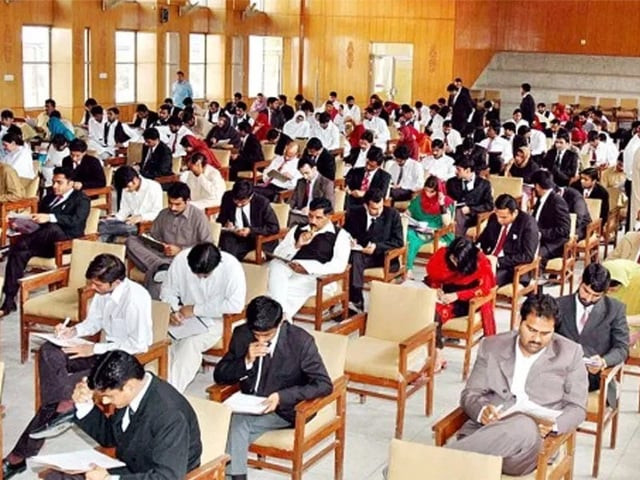
The session opened with a comprehensive briefing on the CSS competitive examination covering the current assessment scheme, screening mechanism and assessment cycle.
A significant recommendation from the meeting was the need to increase the number of exam attempts offered each year.
The committee argued that the current single annual test forces students to stretch their preparation over four years and often lose eligibility due to age restrictions.
It was suggested that the FPSC allows two attempts per year, similar to supplementary tests in other education systems, so that students do not lose years and can stay within the prescribed age groups.
However, the FPSC pointed out that under the current paper-based evaluation system, such a change is not immediately possible due to the time required to assess the syllabus and finalize results.
Another key recommendation of the meeting was to raise the general upper age limit for CSS candidates to 35 years, taking into account various factors that contribute to students’ gap years.
The committee was informed that the screening test (MCQ based) carries 200 marks and serves only as a qualifying stage. The written test includes 600 marks for compulsory subjects with an admission threshold of 40 percent and a further 600 marks for optional subjects with an admission threshold of 33 percent. This brings the total written test to 1,200 marks for which candidates must secure a total of 50 percent (600 out of 1,200) to qualify.
Those who clear the written phase proceed to psychological assessment, medical examination and finally the viva voce which carries 300 marks, of which 100 marks (33 per cent) must be passed. The total credit allocation is based on a total of 1,500 points.


