
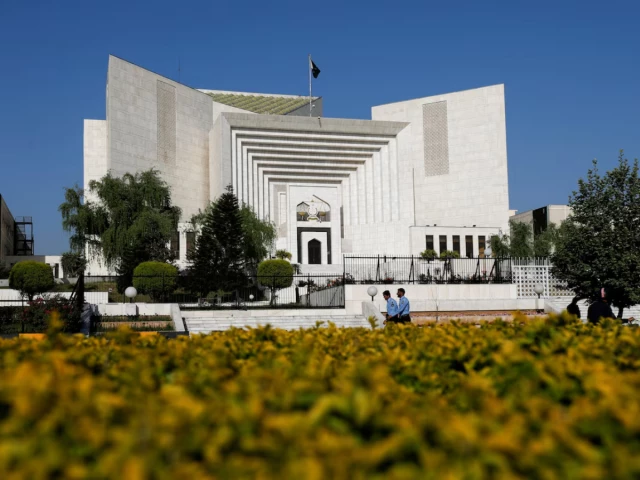
Police officers walk past the Supreme Court of Pakistan building in Islamabad, Pakistan April 6, 2022. REUTERS
ISLAMABAD:
The Supreme Court has expressed serious concern over the filing of frivolous cases by the Federal Board of Revenue (FBR). It has ordered the tax officer to set up committees to review cases before they approach the courts.
“To address this issue, it is imperative for the Chairman, FBR, to consider constituting committees that function with the highest degree of independence and include a retired Judge of the Superior Judiciary, an experienced tax practitioner and senior serving or retired officers of the FBR with distinguished records and impeccable credentials.
“These committees should be mandated to investigate each case in a timely manner before a decision is made to file a referral to a High Court or a petition to this Court.
“The FBR may also consider conducting a review of all pending cases to determine whether the questions of law sought to be raised have already been decided by judgments of superior courts,” said a six-page judgment authored by Justice Miangul Hassan Aurangzeb.
Justice Aurangzeb was part of a three-member bench headed by Justice Naeem Akhtar Afghan that dismissed an FBR application in a taxpayer-related case.
The court lamented that when government departments routinely file appeals or petitions—often up to the high courts and the Supreme Court—on questions of law that have already been authoritatively decided, the practice results in serious institutional harm.
“The most immediate consequence is docketing. Courts are forced to spend scarce judicial time reviewing issues no longer res integra, at the expense of unresolved legal and constitutional issues, criminal appeals involving personal liberty, and civil disputes pending for years.
“This undermines the constitutional mandate of speedy justice. Repeated appeals or petitions for settled law undermine respect for Article 189 of the Constitution, the doctrine of stare decisis and legal discipline within the executive branch.
The judgment observed that when the state itself overrides binding precedent, it sends the wrong signals to subordinate courts, tribunals and trials.
Such appeals and petitions, it said, result in unavoidable legal costs and consumption of public funds for legal counsel, court fees and administrative processing.
The court further noted that the state is expected to act as a responsible and fair litigant, not as a coercive appellant or petitioner. The practice and tendency within public authorities to file appeals or petitions mechanically – especially when the outcome is predictable in the light of settled law – has already been condemned by the court in previous judgments.
The court also noted that it already possesses both the constitutional authority and legal tools to address the problem of repeated appeals or petitions by government departments on settled questions of law.
“Not only can the courts dismiss such appeals or petitions in limine, one of the most effective tools is the imposition of costs. In serious cases, the courts can also require the identification of the official who authorized the filing of the appeal or petition.
“It is imperative that there is internal accountability within government departments and careful legal scrutiny before appeals or petitions are filed.
“Had such an inquiry occurred prior to the filing of the instant petition, it would have been realized that the primary question of law sought to be raised has already been authoritatively decided by a series of judgments of this Court.”
The judgment further noted that despite the law laid down by the SC – binding on the FBR under Article 189 of the Constitution – the petitioners tried to “reinvent the wheel” by arguing that the period of 120 days prescribed in the first proviso to Section 11(5) as substituted by Section 11G(2) instead of issuing an order in the Act is mandatory, rather than issuing an order.


