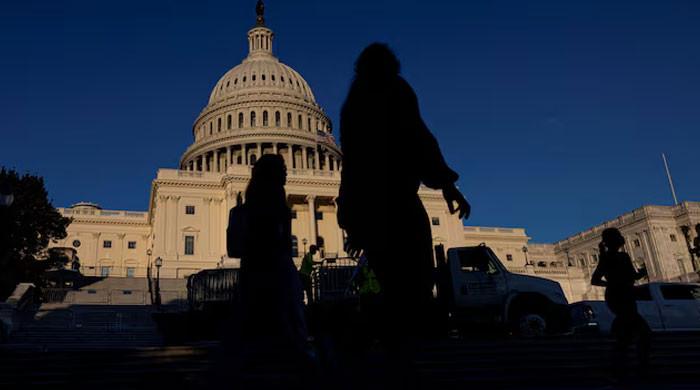
- Senators vote 52 to 47 to advance war powers resolution.
- Republicans blocked the last resolution by only two votes.
- Maduro’s capture led to fears of a protracted Venezuelan campaign.
WASHINGTON: The US Senate on Thursday tabled a resolution that would bar President Donald Trump from further military action against Venezuela without congressional authorization, a rare rebuke of the Republican leader.
The vote on a procedural measure to advance the war powers resolution was 52 to 47, with five of Trump’s Republicans voting with every Democrat to advance. One Republican senator did not vote.
The vote came just days after US forces captured Venezuelan President Nicolas Maduro in a dramatic military raid in Caracas on Saturday. The rebuke of Trump, a day after senior cabinet members briefed every member of Congress on their Venezuela policy, marked a shift in the 100-member Senate.
It was a significant victory for lawmakers who have argued that Congress, not the president, should have the power to send troops to war, as outlined in the Constitution.
However, the resolution faces steep hurdles before it takes effect.
Even if it passes the Senate, the resolution must also pass the Republican-led House of Representatives and achieve a two-thirds majority in both the House and Senate to survive an expected Trump veto.
Trump’s Republicans had blocked two previous attempts to advance similar resolutions in the Senate last year as the administration increased military pressure on Venezuela with attacks on boats in the southern Caribbean and the eastern Pacific.
However, the vote that blocked the final resolution in November was only 51-49, just after Trump’s top advisers told lawmakers they did not plan to change the government or conduct strikes on Venezuelan territory.
After Maduro’s capture, some lawmakers accused the administration of misleading Congress, including Democrats publicly and some Republicans behind the scenes. Maduro’s capture and Trump’s rhetoric have also raised concerns about military action to seize Greenland, an Arctic island that is a territory of Denmark, or against Colombia, Cuba or Iran.
Thursday’s vote paved the way for Senate debate and a vote on final passage in the Senate next week.
Republican concerns
Senator Rand Paul, a Kentucky Republican who co-sponsored the resolution, had said some of his fellow Republicans were considering supporting the measure.
“I can’t guarantee you how they’ll vote, but at least two are thinking about it, and some of them are speaking publicly about their misgivings about this,” Paul told a news conference Wednesday with Democratic Sen. Tim Kaine of Virginia, another co-sponsor.
Both senators are members of the Foreign Affairs Committee.
After the vote, Kaine said it was a “great victory” and told reporters, “None of us should want this president, or any president, to take our sons and daughters to war without notice, consultation, debate and a vote in Congress.”
The five Republicans who voted to proceed were Paul, Susan Collins of Maine, Josh Hawley of Missouri, Lisa Murkowski of Alaska and Todd Young of Indiana. Trump’s party has a 53-47 majority in the Senate.
Trump said the five “should never be elected to office again.” He said on his Truth Social website: “Republicans should be ashamed of the senators who just voted with Democrats who tried to take away our powers to fight and defend the United States.”
‘Endless War’
Supporters acknowledge the hurdles the measure faces, but said many Republicans may be wary of a lengthy and costly government change campaign in Venezuela as the United States faces large budget deficits.
Trump on Wednesday called for a huge increase in US military spending to $1.5 trillion from $1 trillion.
Senate Democratic Leader Chuck Schumer of New York noted months of U.S. attacks on Venezuelan boats and Trump’s statement in a New York Times interview that the U.S. would be involved in Venezuela for more than a year.
“The president is openly signaling a long-term military and financial commitment overseas without authorization, without a plan, another endless war,” Schumer said at a news conference.
Senators who opposed the resolution said Maduro’s seizure was a law enforcement operation, not a military action. Maduro is on trial in a US court on drug and weapons charges to which he has pleaded not guilty.
Opponents also said Trump is within his rights as commander-in-chief to take limited military action.
“The purpose of this resolution is to slap the president in the face. It won’t do anything it purports to do because it can’t stop anything that isn’t happening right now,” Sen. Jim Risch of Idaho, the Republican foreign affairs chairman, said in a Senate speech before the vote.