
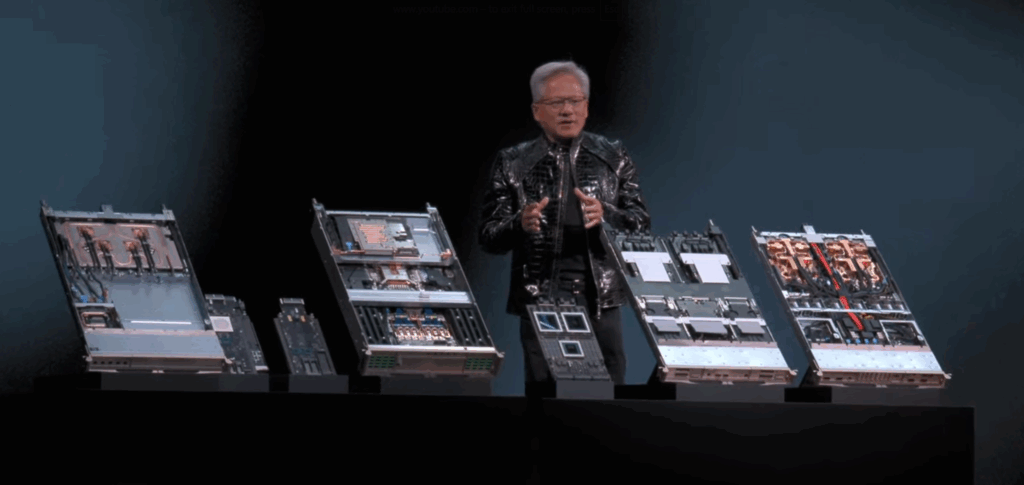
Nvidia CEO Jensen Huang has declared a new age of artificial intelligence in 2026 as demands from around the world continue to grow.
Speaking on stage at CES 2026 in his opening keynote, Huang praised the work his company has done in recent years, but hinted that things will only grow even more going forward.
Everything changes
“Every 10 to 15 years, the computing industry resets—there’s a new shift,” Huang declared, “and each time the world of applications targets a new platform.”
“Except this time, there are two simultaneous platform shifts happening at the same time,” he added — namely AIs and applications built on AI tools, but also how software is run and developed now on GPUs rather than CPUs.
“The whole stack is being changed,” he added, “computing has been fundamentally reshaped as a result of accelerated computing, as a result of artificial intelligence … every single layer of that five-layer cake (of AI) is being reinvented.”
Sporting a brand new leather jacket and battling some tech gremlins, Huang noted how billions of dollars are being invested in AI and research, and how “modernizing AI to AI” will be critical to achieving the next big breakthroughs.
He hailed the “incredible year” of 2025, “where it seemed like everything was happening – and to be honest, it probably was” and the AI industry was taking big steps forward.
He particularly praised Nvidia’s work with open models, via its DGX platform, which has helped solve problems in healthcare and cellular research, as well as its Earth-2 model to improve weather forecasting, and in its new Alpamayo model for autonomous vehicles.
Huang also revealed that Nvidia’s next-generation Vera Rubin chips are now in full development, helping to pave the way for the next step in AI.
With over 17,000 components, the chips bring together a Vera CPU and two Rubin GPUs to provide a massive step forward in power and performance, and the building blocks for the hyperscaled racks required for Nvidia’s AI factories.
“Complete Unknowns”
Huang also spent some time discussing “physical AI” – a system that is truly capable of understanding the actual world around us.
The “complete unknowns … of the common sense of the physical world” pose a unique challenge, but one Nvidia seeks to solve with models like Cosmos, Gr00T and Alpamayo, which take in synthetic data to learn more about the world around them.
Concluding on Nvidia’s goal of building “one central platform for artificial intelligence,” Huang outlined how “our job is to create the entire stack so that all of you can create incredible applications for the rest of the world.”
TechRadar will extensively cover this year’s CESand will bring you all the big announcements as they happen. Head over to ours CES 2026 news page for the latest stories and our hands-on verdicts on everything from wireless TVs and foldable screens to new phones, laptops, smart home gadgets and the latest in artificial intelligence. You can also ask us a question about the show in our CES 2026 live Q&A and we will do our best to answer it.
And don’t forget it follow us on TikTok and WhatsApp for the latest from the CES show floor!


