
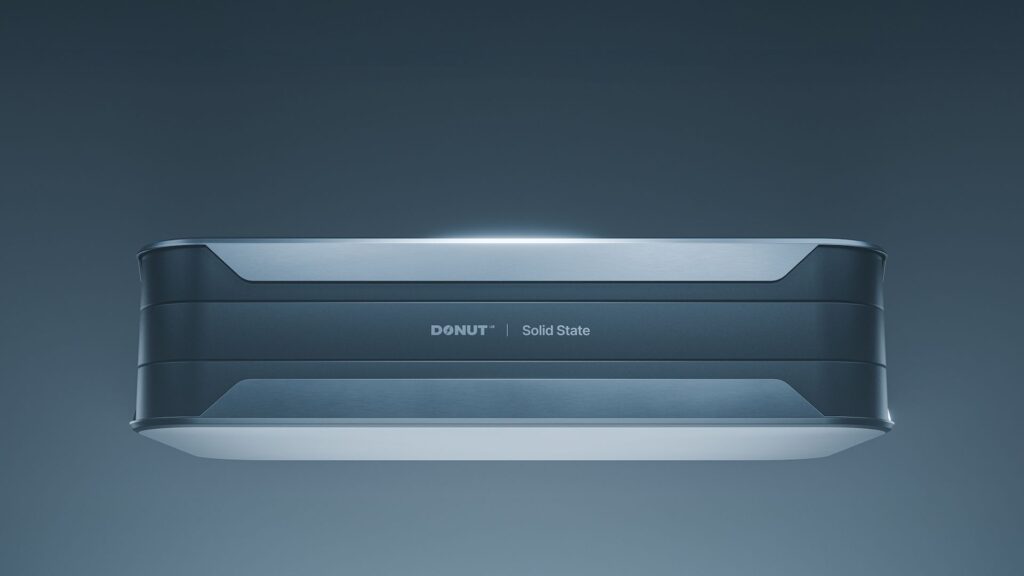
- Donut Lab recently announced the first solid-state motorcycle battery
- This week it revealed test results showing the battery’s charging capabilities
- However, there are still doubts about its lifespan and practical function
Donut Lab sent certain areas of the internet into meltdown earlier this year when it unveiled its first solid-state battery at CES — apparently beating every major battery maker in the process. And it’s battery test results have now been released to help sway the doubters.
The innovative battery pack, which is due to power upcoming versions of the Verge TS Pro electric motorcycle, is claimed to boast 400 Wh/kg energy density, which far outweighs anything the current generation of lithium-ion batteries can offer.
Donut Lab also stated that its battery technology is designed to last up to 100,000 charge cycles, which again far exceeds existing technologies. It can also operate in extreme conditions and charge at high speeds without the need for active cooling.
This is what has made it so attractive for Verge motorcycles and other compact applications, as the relatively light battery packs provide superior range and charging performance without the need for bulky cooling accessories that can add a serious weight disadvantage to something as small as a motorcycle.
But some industry insiders are hitting back at these Donut Lab claims, with Svolt Energy chairman Yang Hongxin claiming that “all the parameters are contradictory” and that any engineer with basic knowledge would recognize that,” according to Electrek.
In an attempt to prove its point, Donut Lab has released results from battery tests conducted by the internationally recognized Technology Research Center VTT, which analyzed charging rates of the company’s first series-producible solid-state battery.
Where most of today’s actively cooled lithium-ion battery packs typically charge at 1C to 3C, or where a charger delivers one to three times the battery’s current capacity, Donut Lab’s solid-state offering managed 5C in tests with only passive aluminum heat sinks (commonly known as heat sinks) used to dissipate heat.
At 5C, the battery cell reached an 80% state of charge in approximately 9.5 minutes. The research center then cranked things up to a charging rate of 11C, charging the cell from 0 to 80% in 4.5 minutes.
During the 5C tests, the cell temperature only rose from 27C to 61.5C, which is considered closest to minimal thermal management.
Too good to be true?
It’s worth noting that one of the 11C tests was aborted after the cell’s surface temperature hit the research center’s 90C safety limit, forcing the team to let the cell cool and reuse the heatsink configuration.
It wasn’t mentioned in the research notes, but this could be a potential problem for those charging in much warmer climates, where cell temperatures could skyrocket during ultra-fast charging sessions and greater thermal management might be needed.
Despite this, Donut Lab will be releasing a series of blog posts and videos under the catchy umbrella title “I Donut Believe” aimed at backing up its bold claims at CES.
As this first test only seemed to cement the fact that its cells can charge quickly, Donut Lab needs to prove to the world that it can do this continuously for the claimed 100,000 charge cycles, as well as demonstrate the pack’s robustness in extreme weather and climates.
There’s also no word on cost, or if this solid-state technology can be scaled to a point where it can be applied to larger electric vehicles in a way that’s considered cost-effective by the auto industry.
All that’s left to do now is keep an eye on Donut Lab’s website for further test results, the next installment of which will go live in less than a week. Who could have predicted that advances in solid-state battery technology could be turned into a Netflix-style series?
Follow TechRadar on Google News and add us as a preferred source to get our expert news, reviews and opinions in your feeds. Be sure to click the Follow button!
And of course you can also follow TechRadar on YouTube and TikTok for news, reviews, video unboxings, and get regular updates from us on WhatsApp also.


