
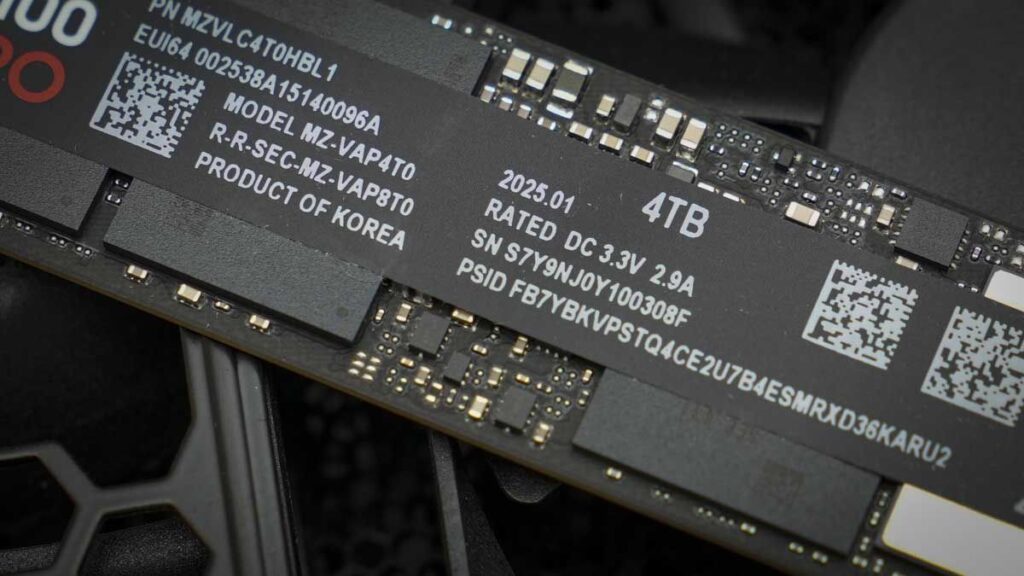
- SSDs have increased in price over the past month and a half
- Tom’s Hardware compared the price of some top-end SSDs to gold in terms of their relative weight
- It turns out that high-end 8TB SSDs are, on average, worth more than gold now by weight – and a few 4TB models are too
If you’ve ever wondered whether SSDs are worth more than gold, gram-for-gram, by weight — and some people have, after price inflation driven by the memory crisis — the answer is, quite unbelievably, yes, at least for capacious high-end drives.
Tom’s Hardware reports that a Reddit discussion popped up around this topic, and our sister site ran some comparisons of the relative cost-to-weight ratios of 24k gold versus certain NVMe SSD models.
These are, of course, the compact stick-style SSDs that plug into your motherboard via an M.2 slot. (It’s worth noting that SATA SSDs, which are much slower than NVMe drives, are in danger of being pulled by a major manufacturer, Samsung, which you may have seen recently.)
To find out, Tom’s compiled a list of SSDs (over 100) from major US retailers (Newegg, Microcenter, Best Buy and Walmart) that were all PCIe 4 or 5 models with at least 4TB capacity (and currently in stock). These were all consumer models with expensive enterprise drives (loaded with a lot of extra bells and whistles) that weren’t considered to throw off the overall value equation.
And of course, no SSD with a heatsink was included, as that adds a lot to the weight (which averaged around 8 grams for 4TB models and only slightly more at 8.2 grams for 8TB drives).
With the 8TB models, Tom found that the average price is now $1,476 with their sample. And the price of 8.2 grams of gold? That’s about $1,200, based on a price of $148 per grams at the time of the comparison.
So these top-end SSDs are more than worth their weight in gold, literally.
As for the 4TB SSDs, they are not yet there with their average price, but a few of the very best models are passing the price of the equivalent weight in gold.
Analysis: storage pain
Unfortunately, storage follows in RAM’s footsteps. While the price of SSDs hasn’t risen as much as system memory has, it’s already gotten pretty bad.
Tom’s shows us a graph of 4TB NVMe drive prices from PC PartPicker, and you can clearly see that prices rose significantly in December, and there’s been an even sharper rise in the first half of January. Hence this eyebrow-raising comparison to the price of gold, and it’s even worse with faster 8TB models.
Where are we going from here? I don’t think it’s too controversial a suggestion that the only way is up. It’s just a matter of what the flight path might be from here and how steep a climb.
So if you need an SSD for an upgrade or new PC build, you might want to pull the trigger on a purchase sooner rather than later (regardless of size, but certainly with top models). For example, you can still get a Samsung 9100 Pro for $600 at Newegg in the US, and even though the same drive was on sale for $400 on Black Friday just a few months ago, odds are it could go up in price at a rate of knots from here.
Looking at our favorite SSD, the WD Black SN8100, the 2TB model was $220 during Black Friday but is now—wait for it—$499 on Newegg. Practice Western Digital models seem to be riding on top of the price hikes, notes Tom’s, although that may relate in part to the popularity of the drives and how quickly stocks are selling through as a result.
It’s ugly out there in warehouse land right now, but it could easily get worse – and it most likely will. In the meantime, we can see some creative solutions floating around, and as we made clear earlier this week, those looking for an SSD for their PS5 could look at an alternative way to solve their storage problems.
The best SSDs for all budgets
Follow TechRadar on Google News and add us as a preferred source to get our expert news, reviews and opinions in your feeds. Be sure to click the Follow button!
And of course you can also follow TechRadar on YouTube and TikTok for news, reviews, video unboxings, and get regular updates from us on WhatsApp also.


