
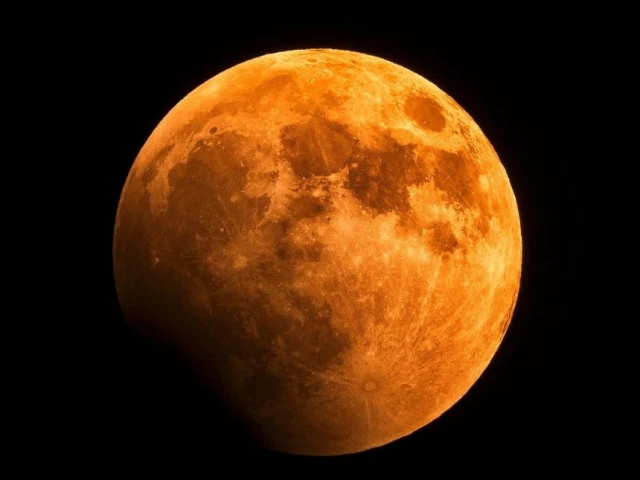
Total lunar eclipse visible in the US and Canada. PHOTO: Pexels
The Pakistan Meteorological Department’s (PMD) Climate Data Processing Center confirmed on Thursday that a total lunar eclipse will be visible in Pakistan on March 3.
According to a press release issued by PMD, the eclipse will be widely visible in Eastern Europe, Asia, Australia, North and South America and parts of the Pacific, Atlantic and Indian Oceans as well as the Arctic and Antarctic. In Pakistan, however, the eclipse will be partially visible at moonrise.
The eclipse will follow a detailed timeline in Pakistan Standard Time (PST). The penumbral eclipse begins at 1:44 p.m. PST, followed by the partial eclipse starting at 2:50 PM PST. The total eclipse will begin at 4:05 PM PST and peak at 4:34 PM PST.
The total eclipse phase ends at 5:03 PM PST, with the partial eclipse ending at 6:17 PM PST. Finally, the penumbral eclipse ends at 7:23 PM PST.
Skywatchers in Pakistan are encouraged to look towards the horizon at moonrise for an opportunity to witness this rare celestial event.
What is a lunar eclipse?
A lunar eclipse occurs when the Earth comes between the Sun and the Moon, causing the Earth’s shadow to fall on the Moon. This celestial event can only happen during a full moon when the Sun, Earth and Moon are aligned in a straight line.
There are three main types of lunar eclipses: total, partial and penumbral. In a total lunar eclipse, the entire Moon passes through Earth’s umbra (the darkest part of its shadow), causing the Moon to take on a reddish hue, often referred to as a “blood moon”.
Read more: Rare ‘Blood Moon’ eclipse to dazzle Pakistan
In a partial lunar eclipse, only part of the Moon enters the Earth’s umbra, while the rest remains in the lighter shadow (penumbra).
A penumbral lunar eclipse occurs when the Moon passes through the Earth’s penumbra, causing a subtle shadow on the Moon’s surface.
Lunar eclipses are safe to observe with the naked eye and are spectacular astronomical events that have been observed and studied for centuries.


