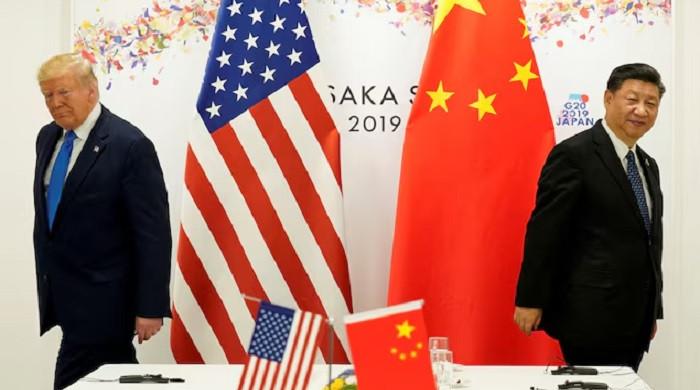
- Software export checks to take effect.
- Trump says ‘no reason’ to meet XI in three weeks.
- Rift between 2 largest economies leaves the markets.
China will beat port taxes on USA-owned, operating, built or marked ships on Tuesday as a countermay for US port taxes on China-bound ships starting the same day, China’s Ministry of Transport said Friday.
Later in the day, US President Donald Trump said he raised tariffs on Chinese exports to the United States to 100% and introduced export control on critical software in a retaliation to export limits from China on rare earth minerals.
There are relatively few US-built or US-flagged ships carrying out international trade, but China will provide more vessels by using taxes with 25% or more of their shares or board seats contained by US-domiciled investment funds, analysts said.
“This throws a wide network and can affect many public shipping companies with a list of US exchanges,” said Erik Broekhuizen, a Marin Research and Consultant Manager at the Ship Broker Company Poten & Partners.
“The potential impact is significant.”
On Tuesday, ships built in China – or operated or owned by Chinese units – will also pay a fee at their first port of emergency in the United States.
Some ships have to pay fees to both China and USA
The US-based shipping company Matson told customers that it is subject to the new China port fees and has no plans to change its service plan.
Also probably affected are CMA-CGM’s US-based US President Lines and Israel-based Zim, which appears to have more than 25% of its shares owned by US units, Lars Jensen, CEO of Container Shipping-Focused Consultancy Vespucci Maritime, said on LinkedIn.
The fees in both China and the United States will apply for 100 ships owned by Poseidon’s Seaspan and chartered by container lines, Jensen said.
Maersk Line Limited, APL, ZIM and Seaspan did not immediately respond to requests for comment on the fees.
Oil tanker operators are mostly based outside the United States, but they can be stabbed by China’s port tax because they are built in the United States, analysts said.
For example, scorpio-tankers have the industry’s largest and youngest fleet and are American-note. It did not immediately respond to a request for comment.
The Chinese port fees “have thrown the tanker market in turmoil,” Broekhuizen said in a client note, adding that many vessels could be affected already on their way to China.
An analysis of Vortexa showed 43 liquid petroleum gas-bearing supertankships, or 10% of the global fleet, will be affected by China’s port fees, said Samantha Hartke, who leads Americas analysis for the energy research company.
Vessels owned or operated by a Chinese unit are facing a fixed fee of $ 50 per day. Netonnage per Sailing to US China-owned carrier Cosco 601919.SS, including its OOCL fleet, is the most exposed with fees of about $ 2 billion in 2026, Analysts said. Cosco did not comment immediately.
China calls us fees discriminatory
The US fees on China-connected ships following a probe by the US Trade Representative are part of a broader US effort to revive the household ship building and blunt China’s naval and commercial shipping.
“It is clearly discriminatory and severely harming the legitimate interests of China’s shipping, seriously disrupting the stability of the global supply chain and severely undermining the international economic and trade order,” the Chinese ministry said.
Ustr’s office did not respond to a request for comment.
Over the past two decades, China has catapulted itself to the No. 1 position in the shipbuilding world, with its largest shipyards handling both commercial and military projects.
The fees announced by China, such as those introduced by the United States, “add further complexity and costs to the global network that keeps moving and economies and the risk of harming their exporters, producers and consumers at a time when global trade is already under pressure,” said Joe Kramk, President and CEO of World Ship Association.
The rates rise for three years
For US-connected vessels, located in Chinese ports starting on Tuesday, the rate will be 400 yuan ($ 56.13) per day. Net metric tons, the Chinese Ministry of Transport said.
It will rise to 640 Yuan ($ 89.81) from April 17, 2026 and to 880 Yuan ($ 123.52) from April 17, 2027.
For vessels calling Chinese ports from April 17, 2028, the tax will be 1,120 yuan ($ 157,16) per year. Net Metrics Ton.
Tensions between China and the United States have been elaborated since September, with the two superpowers who are struggling to move beyond their trading starifvedur – a 90 -day break from August 11, ending around November 9.
Retalatory tariffs in trading in US-China this year have sharply limited Chinese imports of US agriculture and energy products.