
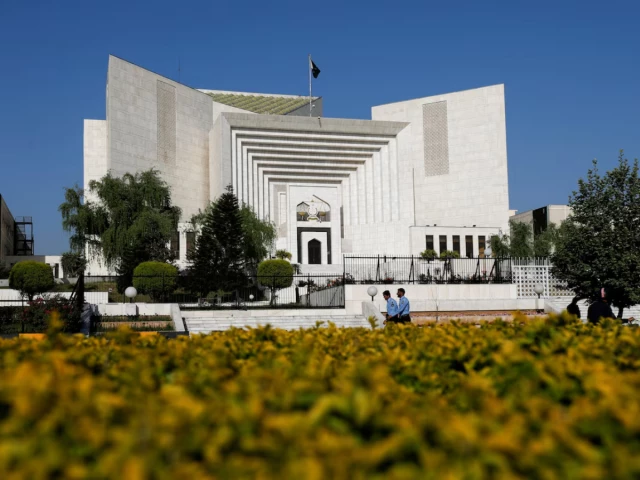
Police officers walk past the Supreme Court of Pakistan building in Islamabad, Pakistan April 6, 2022. REUTERS
ISLAMABAD:
A central policy governing transfers and postings of married civil servants is to undergo a fresh judicial review as the Supreme Court has decided that the scope and applicability of the marriage policy in service cases should be examined by a larger body.
A division bench of the apex court headed by Chief Justice of Pakistan Yahya Afridi, while hearing an appeal filed by the Federal Board of Revenue (FBR) against an order of the Federal Service Tribunal (FST), directed the judicial office to fix the case before a three-member bench for final adjudication.
While hearing the case last month, the bench noted that a recent SC decision had allowed a claim for retention at a particular station based on the marriage policy, leading to a wider debate on whether such exemption could be treated as enforceable in the Service Act.
At this stage, Hafiz Ahsaan Ahmad Khokhar, representing the FBR, raised reservations against Justice Ayesha Malik’s earlier judgement, arguing that the marriage policy could not be enforced as a vested or absolute right of a civil servant in contravention of the Civil Servants Act, 1973, Establishment and Posting Division and the directions of the transfers.
He further pointed out that the official in the instant case had remained posted in Peshawar for more than fifteen years, thereby bringing the case outside the scope and intent of the marriage policy, which he said was subject to administrative requirements and rotation principles.
The lawyer emphasized that the applicability of the policy must be carefully examined in the light of the service legislation and the applicable administrative instructions. Following these arguments, the court referred the case to a three-member panel for final determination.
The referral has sparked debate in legal circles, particularly as to why the case was sent to a grand jury despite the existence of a two-man decision on the marriage policy.
Legal experts suggest that the three-member bench may take a different view from the liberal interpretation earlier adopted by Justice Ayesha Malik regarding the scope and enforceability of the policy.
In December last year, a division bench comprising Justice Munib Akhtar and Justice Ayesha Malik had observed that the state must follow the marriage policy as it was designed to specifically address the difficulties faced by married government employees and unmarried women government employees.
In that judgment, the court held that the government could not selectively apply the policy and emphasized that it must be followed in letter and spirit to remove hardship and to discourage the continued practice of issuing transfer orders without sensitivity to the demands of married employees.
“Therefore, as a matter of propriety, efforts should be made to follow the policy to avoid psychological, financial and social burdens on families,” the judgment said.
The court said that relevant constitutional provisions collectively place a burden on the state to promote the full participation of women in public service and to protect the institution of marriage and family for the benefit of both men and women.


