- Trump issues threat after ICE officer shoots Venezuelan man.
- Says he may deploy military force in Minnesota.
- Minnesota leaders say ICE actions are ‘abhorrent and intolerable.
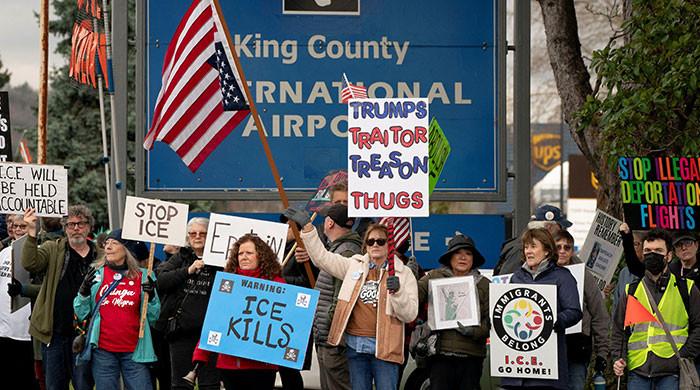
WASHINGTON: US President Donald Trump on Thursday threatened to invoke the Insurrection Act to deploy military forces in Minnesota after days of angry protests over an increase in immigration agents on the streets of Minneapolis.
Confrontations between residents and federal officers have grown increasingly tense since an Immigration and Customs Enforcement agent fatally shot a U.S. citizen, Renee Good, in a car eight days ago in Minneapolis, and protests have spread to other cities. Trump’s latest threat came hours after an immigration officer shot and killed a Venezuelan man the government said was a fugitive after agents tried to stop his vehicle in Minneapolis. The man was wounded in the leg.
“If the corrupt politicians in Minnesota disobey the law and stop the professional agitators and rioters from attacking ICES Patriots who are just trying to do their job, I will enact the INSURRECTION ACT,” Trump wrote on social media.
Trump, a Republican, has for weeks taunted the state’s Democratic leaders, calling people of Somali descent there “garbage” who should be “thrown out” of the country.
He has already sent nearly 3,000 federal officers into the Minneapolis area, who have been carrying guns through the city’s icy streets, wearing military-style camouflage gear and masks that hide their faces.
They have been met day and night by loud, often angry protests from residents, some whistles or beating tambourines. On Wednesday night, crowds of nearby residents gathered near the area where the Venezuelan man was shot. Some shouted in protest, and federal officers ignited flash-bang grenades and released clouds of tear gas.
Later, after most of the residents had dispersed, a small group vandalized a car they believed belonged to federal officers, one person daubing it with red graffiti saying, “Hang Kristi Noem,” referring to the Homeland Security secretary who oversees ICE.
Since the surge began, agents have arrested both immigrants and protesters, sometimes breaking windows and pulling people out of their cars, and have been called out to stop black and Latino citizens for identification.
‘Disgusting and intolerable’
The US Department of Homeland Security, which oversees Trump’s immigration crackdown, identified the man its officer shot as Julio Cesar Sosa-Celis. He had been allowed into the United States by the administration of Trump’s predecessor, Joe Biden, in 2022 through the government’s humanitarian parole program. The Trump administration has since revoked parole granted to Venezuelans and others hospitalized under Biden.
In its statement, DHS called him a convicted felon under Minnesota law after being caught driving without a license and giving a false name to a police officer. Court records from the cases reviewed by Reuters show he was convicted only of “minor offenses,” which Minnesota state law says “do not constitute a felony” and for which the maximum penalty is a $300 fine.
According to the DHS account, federal officers attempted to stop Sosa-Celis in his vehicle. He fled the scene in his vehicle, crashed into a parked car and then ran away on foot, DHS said.
An officer caught him, and while the two were “in a struggle on the ground,” two other Venezuelan men came out of a nearby apartment and “attacked the law enforcement officer with a snow shovel and broom handle,” the affidavit said.
Sosa-Celis broke free and began hitting the officer with “a shovel or broom handle,” and then the officer “fired defensive shots in defense of his life,” the DHS statement said.
Reuters was unable to confirm the account provided by DHS. The men fled into the apartment and all three were arrested after officers entered, DHS said. Sosa-Celis and the officer were recovering at the hospital from injuries, according to department and city officials.
The Trump administration and Minnesota leaders have each accused the other of inciting anger and violence.
In a late-night news conference, Mayor Jacob Frey called the ICE surge an invasion, saying he had seen “behavior from ICE that is disgusting and is intolerable.”
“We can’t be in a place right now in America where we have two governmental entities that are literally fighting each other,” Frey said, calling for peace.
Trump supporters are divided on immigration enforcement
The Insurrection Act of 1807 is a law that allows the president to deploy the military or federalize soldiers in a state’s national guard to quell insurrections, an exception to laws that prohibit soldiers from being used in civil or criminal law enforcement.
It has been used 30 times in American history, according to New York University’s Brennan Center for Justice. The Supreme Court has determined that the president alone can decide whether the conditions of the law have been met.
Trump has already taken the unusual step of federalizing National Guard troops to help with immigration law enforcement in Democrat-run cities over objections from state governors, including in Los Angeles last year, which a judge ruled in December was unconstitutional.
Trump’s aggressive moves in Minnesota have divided his supporters: 59% of Republicans favored a policy that prioritizes arrests by immigration officers even if people get hurt, while 39% said officers should focus on not hurting people even if it means fewer arrests, according to a Reuters/Ipsos poll released Thursday.
If Trump sends troops to Minnesota, he will almost certainly face legal challenges from the state. The Minnesota attorney general’s office already sued the Trump administration this week, saying ICE agents engaged in a “pattern of illegal, abusive behavior,” including racial profiling and forced entry into residents’ homes without warrants. The American Civil Liberties Union also filed a similar lawsuit against the Trump administration on Thursday.
At a brief hearing Wednesday, Minnesota asked U.S. District Judge Kate Menendez to issue a temporary order limiting the ICE surge.
Menendez ordered the Trump administration to respond by Monday and said she would rule after that, calling the issues raised by Minnesota’s lawsuit “tremendously important.”