
ISLAMABAD:
Opposition leaders on Saturday strongly condemned the sentencing of PTI founder Imran Khan and his wife Bushra Bibi in the Toshakhana-II case, denouncing the verdict as a blow to justice and a stark symptom of a wider unraveling of constitutional order, judicial credibility and democratic accountability in the country.
The condemnation coincided with a wider mobilization at the national conference of Tehreek Tahaffuz-e-Aeen Pakistan (TTAP), where political leaders, lawyers, journalists, intellectuals and civil society representatives agreed that the moment called for resistance rather than reconciliation.
They supported a street movement as the only way left to push back against constitutional backsliding and to defend democracy and fundamental rights.
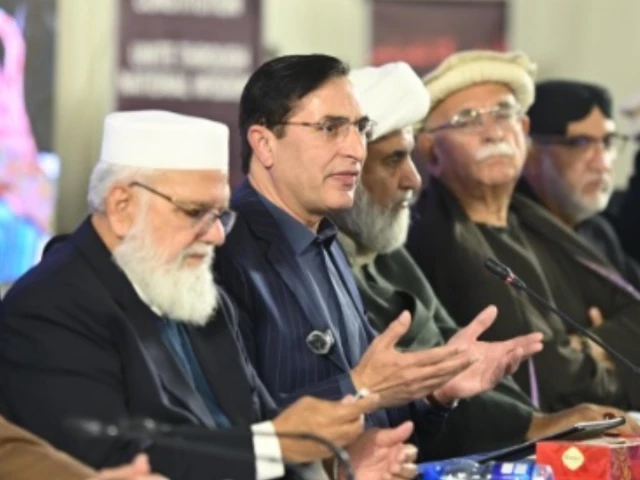
At a press conference at Khyber Pakhtunkhwa House, Islamabad, opposition leaders warned that such rulings would only add fuel to an already simmering political divide and further erode public confidence in state institutions.
They said the verdict revealed a familiar pattern of selective accountability, in which the scales of justice appeared to be skewed, power set the conditions and meaningful relief remained out of reach for ordinary citizens and political dissenters alike.
Addressing the media, PTI Chairman Barrister Gohar Ali Khan said that the party unequivocally rejected the verdict given to Imran Khan and Bushra Bibi in the Toshakhana-II case. He warned that such rulings would create unrest and instability, adding that public confidence in the justice system is rapidly eroding.
TTAP chief Mahmood Khan Achakzai said that the punishment of those who spoke for rights cannot be termed as justice. He said people would inevitably question such rulings, especially in a country where massive corruption scandals involving billions of rupees were well-known but largely unpunished.
He said selling or buying conscience seemed to have become the yardstick for being considered a “good Pakistani”.
Akhtar Mengal said on the occasion that the verdict deserved the strongest condemnation when he asked if no former prime ministers had taken items from Toshakhana and if any of them had ever been punished.
Allama Raja Nasir Abbas said the judgment was reprehensible, adding that both the public and Parliament had been rendered irrelevant. He alleged that public rights were effectively being plundered in parliament and accused the government of trying to demoralize the opposition, a strategy he said would fail.
Former senator Mustafa Nawaz Khokhar also condemned the sentencing, saying political victimization was no longer limited to politicians.
Citing cases against lawyer and human rights activist Iman Mazari for raising public issues, a drug case against journalist Matiullah Jan and the impeachment of Judge Tariq Mahmood Jahangiri, he said his only “crime” was speeding out of bail and election-related cases involving the PTI founder.
The courts should be boycotted
PTI leader Firdous Shamim Naqvi said the verdict had exposed the judicial system and said it had become clear that the courts of Pakistan were no longer delivering justice. He said PTI workers were facing about 65,000 cases and went on to suggest that the courts should now be boycotted.
He warned that “fabricated verdicts” created a dangerous vacuum and cited a UN report saying ongoing actions were neither constitutional nor legal, but inhumane.
Zubair Umar said the opposition was deeply saddened by the sentences handed down to Imran Khan and Bushra Bibi, as well as the sentences given to Yasmin Rashid, Umar Sarfraz Cheema, Mian Mahmoodur Rashid and Ejaz Chaudhry.
He said the judiciary had effectively been dismantled and asked who would trust judgments handed down without proper trials. He questioned the logic of convicting senior leaders in the seventies, calling it blatant oppression, saying the injustice would continue unless the government itself was challenged.
At the national conference, participants unanimously agreed that reconciliation with the establishment had failed and that resistance was now inevitable.
Political leaders rejected constitutional changes, condemned the weakening of parliament, while lawyers condemned the erosion of judicial authority, and journalists raised alarm over the PECA law, which they said criminalized free speech.
Achakzai urged leaders including Maulana Fazlur Rehman, Nawaz Sharif and Jamaat-e-Islami to sit together for dialogue while insisting that the mandate for the February 8 elections be accepted. He said that dialogue was only possible if permission was granted to meet Imran Khan, stressing that meetings with family and political leaders was a fundamental right, regardless of belief.
Veteran politician Javed Hashmi said that nations achieved freedom through prisons and sacrifices, adding that rights were won through perseverance rather than retreat. He rejected divisive politics and said dialogue, not slogans or confrontation, was the only viable solution.
PTI leader and senior advocate Salman Akram Raja said the Toshakhana-II judgment had come unexpectedly during a scheduled hearing, adding that the issue crossed party lines and affected the entire nation.
He said the country must decide whether to continue to endure repression or resist it, conveying Imran Khan’s message that the nation should prepare for a street movement.
Former National Assembly Speaker Asad Qaiser said the opposition had no option but to take to the streets, insisting that fear would not deter them and that they were demanding justice strictly on merit.
Jamaat-e-Islami leader Liaqat Baloch called for strengthening every national voice for free and impartial elections. He demanded the rollback of constitutional amendments passed through “an artificial majority”.
Lawyer Iman Mazari said PTI remained the country’s most popular party because the public had given its mandate to Imran Khan. Although she was not a PTI supporter, she said she and others would stand shoulder-to-shoulder with the PTI if it opted for opposition, stressing that the issue was no longer about a single leader but about the mandate of the people.
She condemned the treatment of Imran Khan’s sisters outside the Adiala jail and said such behavior must be opposed collectively, whether it is directed at Mahrang Baloch, Imran Khan or Ali Wazir.
PTI chairman Barrister Gohar said the movement launched two years ago had now become an organized national voice. Alleging systematic theft of PTI’s mandate, including loss of reserved seats and by-elections, he said Imran had empowered Achakzai and Allama Raja Nasir Abbas to decide whether the opposition should pursue dialogue or resistance, adding that Imran Khan and his 30 million voters were behind them.


