
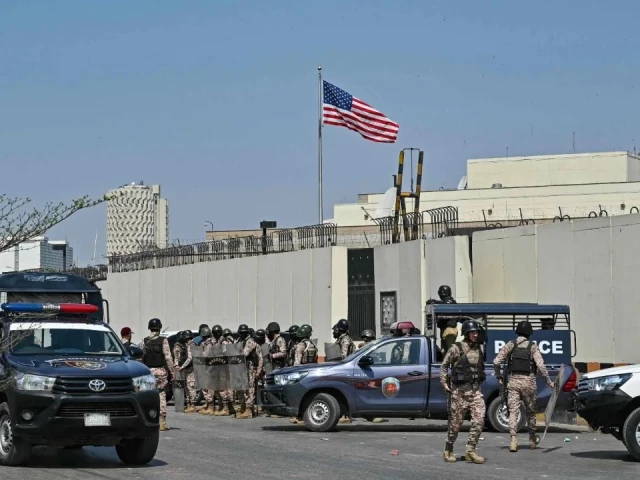
Travel advisories keep the country at level 3, citing risks from regional tensions and terrorism
Security personnel stand guard outside the US consulate in Karachi on March 1, 2026. PHOTO: AFP
The US has ordered the departure of non-emergency personnel and eligible family members from its consulates in Lahore and Karachi, the US State Department said in an updated travel advisory on Wednesday.
In its latest travel advisory on Pakistan, which maintains Pakistan at Level 3, meaning travelers should reconsider travel, the State Department said the move was made due to security risks following heightened regional tensions.
Pakistan: The State Department updated the travel advisory for Pakistan to reflect the ordered departure of non-emergency U.S. government personnel and family members of government personnel from the U.S. consulates Lahore and Karachi. Read the entire guide: pic.twitter.com/ABO11FPWZp
— TravelGov (@TravelGov) March 4, 2026
There was no change in the status of the US Embassy in Islamabad, it added.
Tensions between the US, Israel and Iran have sharply escalated following coordinated US-Israeli air and missile strikes on Iranian targets on February 28, 2026. The operation – aimed at containing what Washington and Tel Aviv describe as growing security threats and Iran’s nuclear ambitions – triggered swift retaliation against Israeli strikes from Tehran and drone links from Tehran. assets in the Gulf region.
The fallout has spilled into Pakistan following the death of Iran’s Supreme Leader Ayatollah Ali Khamenei, with protests breaking out in several cities. In Karachi, demonstrations turned deadly when crowds trying to march on the US consulate were fired upon, leaving at least 10 protesters dead and dozens injured, according to reports. US Marines opened fire on protesters during the storming of Karachi’s consulate over the weekend, two US officials said Monday – a rare use of force at a diplomatic post that risks sharply escalating tensions in the country amid widespread anger over the killing of Iran’s leader.
Read: The US is canceling visa deals across Pakistan until Friday over security fears
In Islamabad, protesters gathered near key diplomatic and government sites and shouted slogans against the US and Israel, while security was tightened to prevent marches on sensitive zones. Meanwhile, demonstrations were also reported in Skardu and other northern areas where protesters held processions condemning the attacks on Iran. At least 25 protesters died across Pakistan.
The exchange has raised fears of a wider regional conflict, disrupted air travel in parts of the Middle East and intensified diplomatic warnings from global powers calling for restraint as both sides signal readiness for further escalation.
According to the State Department, the ordered departure comes amid a “persistent threat of drone and missile strikes from Iran” and disruptions to commercial flights following hostilities between the US and Iran that began on February 28.
The advisory urges US citizens to reconsider travel to Pakistan due to armed conflict, terrorism, crime and kidnapping – the four primary risk categories listed – and warns that conditions can change rapidly.
High risk areas marked
The State Department reiterated its Level 4 — the highest warning level — advising Americans against travel for:
-
Balochistan Province
-
Khyber-Pakhtunkhwa province, including former FATA
-
The immediate vicinity of the Line of Control
It said extremist and insurgent groups in these areas have carried out deadly attacks targeting civilians, foreign nationals, government offices and security forces, adding that assassinations and attempted kidnappings are common.
The advisory noted that terrorist attacks in Pakistan can occur “without warning” and may target transport hubs, hotels, markets, airports, schools, places of worship and government buildings.
While major cities such as Karachi, Lahore and Islamabad have greater security resources, the overall security environment remains “fluid” and could rapidly deteriorate, it said.
Travel and access requirements
The advisory emphasized that US citizens must obtain a visa before traveling to Pakistan – a mandatory pre-arrival requirement. However, US-Pakistani dual citizens with a valid National Identity Card for Overseas Pakistanis (NICOP) or Pakistan Origin Card (POC) – overseas identity cards issued by Pakistan – are exempt from visa requirements.
Travelers must carry a passport valid for at least six months beyond the date of arrival – the minimum validity rule with two blank pages required for entry and exit stamps.
No vaccinations are required for entry, but authorities may require proof of polio vaccination taken within the past year on departure from Pakistan – a public health protection.
In terms of currency regulations, there is no maximum cash limit on entry, but adults can take up to $5,000 per person. travel and $30,000 per year – the allowable foreign currency cap, while minors are limited to $2,500 per travel and $15,000 per year.
The State Department said U.S. government personnel in Pakistan face strict movement controls and in some areas must travel with armed escorts and armored vehicles – enhanced security protocol.
It also warned that Washington has limited ability to help US citizens – reduced consular reach in certain regions of Khyber-Pakhtunkhwa, Balochistan, Azad Jammu and Kashmir and most areas outside Islamabad, Lahore and Karachi.
Dual US-Pakistani citizens may receive limited consular assistance if detained, as Pakistani law treats them solely as Pakistani citizens.
Advice for travellers
The US Embassy warned travelers that bringing alcohol into Pakistan is illegal, a strict customs ban, and urged visitors to wear modest clothing in public. Women were advised to wear headscarves when visiting mosques or rural areas, while men were warned against wearing shorts.
Americans traveling to Pakistan were further urged to:
-
Avoid demonstrations and large gatherings
-
Monitor local media and adjust plans
-
Vary travel routes and timing
-
Avoid showing signs of wealth
-
Maintain emergency exit plans
-
Get comprehensive travel and health insurance
US citizens were also encouraged to sign up for the Smart Traveler Enrollment Program (STEP) – the State Department’s traveler alert system – to receive updates from the embassy.
The update comes amid heightened regional tensions and follows similar US security advisories issued in recent months.


