
Special Forces Take Out Venezuela’s President, Wife of NY; The US takes control of Venezuela’s vast oil reserves
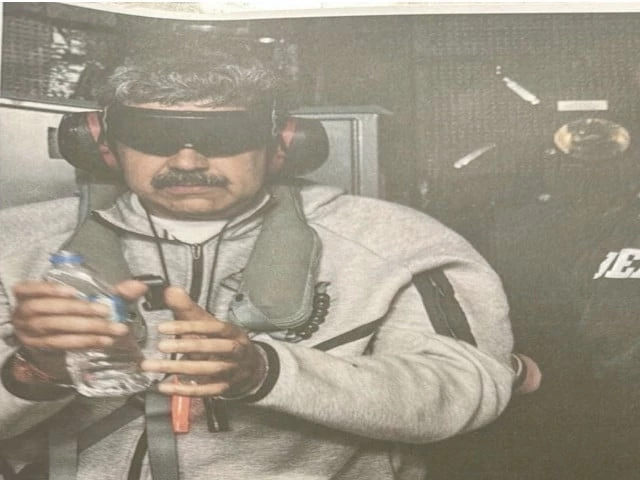
A photo posted on US President Donald Trump’s Truth Social account shows Venezuelan President Nicolas Maduro aboard the USS Iwo Jima after US military captured him. Photo: Reuters
In a dramatic escalation in Latin America, US special forces captured Venezuelan President Nicolas Maduro after bombing the capital Caracas and other cities, President Donald Trump announced on Saturday, marking the most direct intervention by Washington in the region since the 1989 invasion of Panama.
The overnight operation, reportedly carried out in coordination with US law enforcement, involved elite special forces and followed months of accusations from Washington that Maduro ran a “narco state” and manipulated Venezuela’s 2024 elections.
“The United States has successfully conducted a large-scale attack against Venezuela and its leader, President Nicolas Maduro, who, along with his wife, has been captured and flown out of the country,” Trump wrote on Truth Social.
Trump later held a press conference in which he announced that the United States will indefinitely “rule the country” of Venezuela and “rebuild the oil infrastructure.” He said the United States would take control of Venezuela’s vast oil reserves and recruit American companies to invest billions of dollars to renovate the oil industry.
Venezuela’s leader was expected to arrive in New York, where he will face drug and weapons charges. His wife, Cilia Flores, was also taken into custody after the couple was dragged from their bedroom by US elite forces during the overnight raid, a CNN report said.
Washington accused Maduro of overseeing drug trafficking to the United States and its expanded military and economic measures, including attacks on suspected drug vessels. Deputy Secretary of State Christopher Landau said Maduro “will finally face justice for his crimes.”
The Venezuelan leader, a 63-year-old former bus driver handpicked by the dying Hugo Chavez to succeed him in 2013, has rejected those claims, saying Washington was intent on taking control of his nation’s oil reserves, the largest in the world.
Explosions rocked the Venezuelan capital Caracas and surrounding areas, including Miranda, Aragua and La Guaira, prompting the government to declare a national emergency. Venezuela’s government said civilians and military personnel died in the attacks, but did not provide figures.
Witnesses described black smoke and bright flashes in the sky, while power outages disrupted parts of the city near military bases. Despite the strikes, initial assessments reported that Venezuela’s oil production and refining facilities remained operational.
Venezuelan officials condemned the attack. The Maduro government blamed Washington for trying to seize the country’s oil reserves, the largest in the world, and called the strikes a violation of sovereignty.
Vice President Delcy Rodriguez, who is reportedly in Russia, demanded proof of the lives of Maduro and his wife, while Interior Minister Diosdado Cabello appeared on state television in Caracas urging citizens not to cooperate with the “terrorist enemy.”
Defense Minister Vladimir Padrino vowed to resist the presence of foreign troops. “The free, independent and sovereign Venezuela rejects with all the force of its libertarian history the presence of these foreign troops who have left only death, pain and destruction.”
However, Venezuela’s opposition leader María Corina Machado called for an opposition candidate to be installed as leader, while the county’s foreign minister insists Maduro remains the country’s head of state. The capital expressed mixed reactions, with some celebrating. At sunrise, uncertainty was high.
The world expresses alarm and praise
WASHINGTON: The international community reacted with a mixture of condemnation, caution and calls for support for a democratic transition following Saturday’s US attack on Venezuela and the capture of President Nicolas Maduro.
Several European officials, including UK Prime Minister Keir Starmer, European Commission President Ursula von der Leyen, Denmark’s Mette Frederiksen, Italy’s Giorgia Meloni, Norway’s Espen Barth Eide and Slovakia’s Robert Fico called for compliance with international law, de-escalation and diplomatic solutions.
Other global reactions ranged from praise to concern. Canadian Foreign Minister Anita Anand supported Venezuela’s peaceful democratic aspirations. Belarus’s president, Alexander Lukashenko, and Iran’s foreign ministry condemned the strikes as violations of sovereignty. Trinidad and Tobago Prime Minister Kamla Persad-Bissessar confirmed his country’s lack of involvement, while Britain’s Nigel Farage acknowledged the move as unorthodox but suggested it could pressure China and Russia.
French President Emmanuel Macron called for a peaceful and democratic transition and called for 2024 President-elect Edmundo Gonzalez Urrutia to be allowed to guide the country. “We hope that President Gonzalez Urrutia will be able to secure this transition as soon as possible,” Macron wrote on X.
German Chancellor Friedrich Merz warned that the operation’s legal assessment is complex, adding that a transition to a government legitimized by elections must be ensured to avoid political instability.
Spanish Prime Minister Pedro Sanchez said his country had not recognized the Maduro regime, but added that it also could not tolerate interventions that violate international law or push the region toward insecurity and warfare.
UN Secretary-General Antonio Guterres reiterated concerns over the legality, and his spokesman described the strikes as a “dangerous precedent” and stressed the importance of respecting international law.
China and Russia strongly condemned the strikes. China called the operation “deeply shocking” and Russia described it as armed aggression, calling for dialogue to prevent escalation.
Latin American leaders were similarly divided. Argentina’s President Javier Milei hailed the removal of Maduro as “excellent news for the free world”, while Mexico’s Foreign Ministry condemned the strikes as a violation of the UN Charter.
Paraguay, Bolivia, Panama, Peru, Uruguay and Chile called for peaceful, democratic solutions and respect for international law, with an emphasis on humanitarian considerations and orderly transitions.
Brazilian President Luiz Inacio Lula da Silva warned that the attacks represented a “serious violation of Venezuela’s sovereignty” and a dangerous precedent for the international community.
Colombia’s President Gustavo Petro expressed concern over regional instability, while Ecuador’s President Daniel Noboa declared the collapse of the “narco-Chavista” regime inevitable.


