
Shavkat Mirziyoyev is to meet President Zardari and hold delegation-level talks with Prime Minister Shehbaz
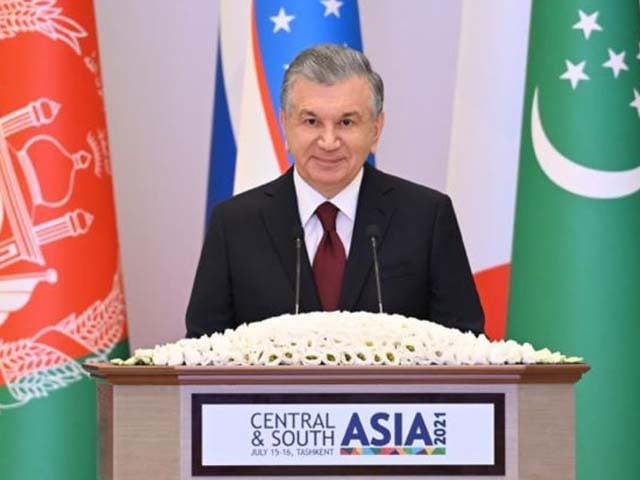
President of Uzbekistan, Shavkat Mirziyoyev speaks during a conference. PHOTO: AFP
The Ministry of Foreign Affairs (MOF) said on Wednesday that Uzbekistani President Shavkat Mirziyoyev will pay a two-day state visit to Pakistan from 5-6. February.
According to the foreign ministry, the Uzbek president would meet President Asif Ali Zardari, hold delegation-level talks with Prime Minister Shehbaz Sharif and address the Pakistan-Uzbekistan Business Forum during his stay.
“The drafts will focus on reviewing the full spectrum of bilateral relations and identifying new avenues to further deepen cooperation in various sectors, including trade, energy, defence, education, people-to-people exchanges and regional relations,” the FO said.
He will lead a high-level delegation, consisting of senior ministers and business leaders,
The FO said it would be his second visit to Pakistan, reflecting the “upward trajectory” of Pak-Uzbek bilateral relations and the fraternal ties between the two countries rooted in common history, faith and “shared aspirations for peace and prosperity in Central and South Asia”.
Pakistan and Uzbekistan have strong diplomatic and economic relations, with the leaders of both countries often visiting each other to further strengthen bilateral ties.
Earlier this week, Pakistan and Uzbekistan agreed to accelerate efforts to raise bilateral trade to $2 billion as the 10th session of the Pakistan-Uzbekistan Intergovernmental Commission on Trade, Economic and Scientific-Technical Cooperation concluded in Islamabad.
Both sides expressed satisfaction with the steady progress in bilateral engagement and reaffirmed their commitment to expanding trade, investment and economic cooperation. They stressed the importance of the preferential trade agreement, welcomed progress under Phase II concessions and agreed to speed up institutional mechanisms to reach the $2 billion trade target.
The discussions emphasized trade facilitation, logistics improvement, customs digitization, transit trade cooperation, development of regional trade corridors and increased business-to-business engagement along with enhanced visa facilitation for business communities.


