
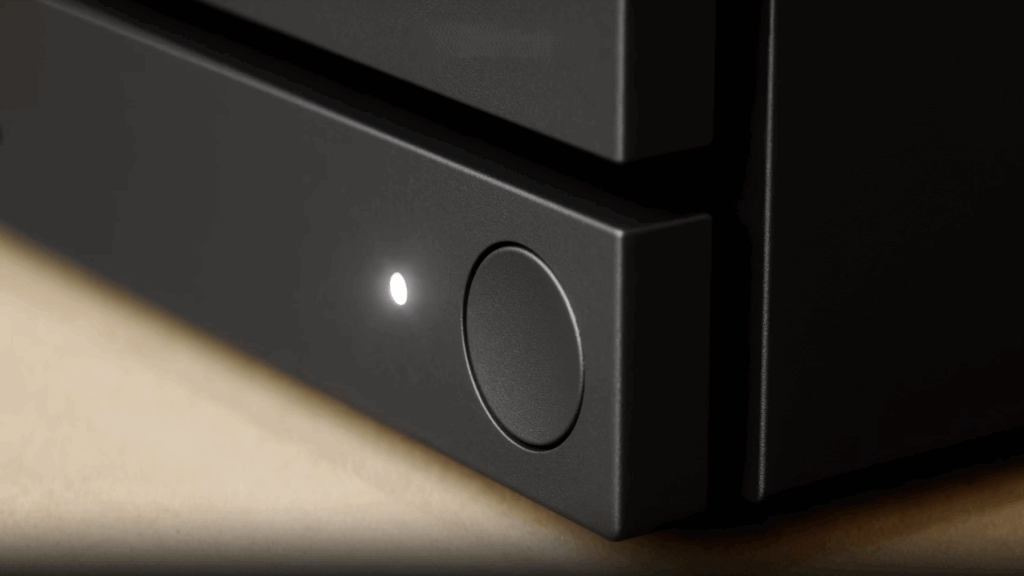
- A valve engineer has confirmed that the company will not subsidize the Steam Machine
- Hopes for a $500 price have been dashed
- The likelihood is that the device will cost more like $800, but Valve will look to add value in different ways compared to a similar gaming PC
A Valve engineer has confirmed that the Steam machine will not have its prices subsidized, console-style, dashing the hopes of many that we could see a $500 living room PC.
Wccftech announced an interview YouTuber Skill Up conducted with Valve software engineer Pierre-Loup Griffais on the Friends Per Second podcast where the subject of the Steam Machine’s price was discussed, and specifically the possibility of a Valve subsidy for the device.
The YouTuber asked, “But it’s not going to be some sort of subsidized entity like Valve isn’t going into the mindset that we’re going to eat a big loss on this so we can grow market share or category or something like that, right?”
Griffais replied: “No, it’s more in line with what you’d expect from the current PC market. Obviously, our aim is for it to be a good deal at that level of performance.
“And then you have features that are actually really hard to build if you’re building your own gaming PC from parts. Things like the small form factor, the noise level that we achieved, or lack thereof, is really impressive, and we’re excited for people to find out how quiet this thing is.
“But also some integration features like HDMI CEC. The Bluetooth and wireless work we’ve done, the four antennas, the very conscious design so you can have a great experience with four Bluetooth controllers.”
So that’s a definite ‘no’ in terms of there being a subsidy to keep the lid on the price of the Steam Machine, and it backs up some other talk we’ve heard recently.
As mentioned at the outset, the hope for many was the possibility of a $500 price tag, and Wccftech notes that this number was mentioned by Linus Tech Tips in a room with some Valve employees and that ‘the energy wasn’t great’, meaning it was apparently clear enough that this was too low a number.
The claim here that pricing will be “in line with what you’d expect from the current PC market” also echoes earlier statements that the Steam Machine is “very competitive with a PC you could build yourself out of parts” (as Griffais said in a previous chat with The Verge).
Look at
Analysis: complex pricing equations and added value elsewhere
So what is the result here? Gamers now believe that Valve is looking more at the $800 mark for the Steam Machine. And that was actually The Verge’s guess at what a comparable home-built PC might cost to deliver the same kind of gaming performance as the AMD chips in the Steam Machine (which will have a semi-custom GPU from Team Red, it should be noted).
Keep in mind that the Steam Machine is being pitched to be better than (or equal to) 70% of the gaming PCs out there on Steam (according to Valve’s hardware survey). In other words, it won’t be anything sloppy, but expectations must clearly be managed around the Zen 4 chip and RDNA 3 GPU, which some feel sounds rather underpowered. (Some of the heavy lifting will be done on the software side, mind you, with the custom tuning for that GPU and AMD’s FSR).
In any case, it now seems that the intention is now to strongly discourage any thought of a cheap price somewhere in the $500 range – and the idea that Valve could take a loss on the hardware because it wants to make money on the software. (Perhaps a lot of money from sales of Steam games – of which Valve gets a 30% cut, for most games that is, in addition to top sellers – if there are lots of Steam machines in living rooms around the globe).
What Valve’s engineering seems to be saying here is that what you’re getting is a mini PC that costs the same as a similarly capable, larger desktop gaming PC, but you’ll get a lot more benefits with the Steam Machine’s form factor and design.
The steam machine will be quiet, compact and discreet (without a power block) – it will fit nicely into the living room. The device turns on instantly with an easy-to-use interface for your big-screen TV, and you can resume a gaming session immediately. Only have 15 minutes to play? No problem, you can jump right into a quick game in the short amount of time you have before you leave the house.
Griffais also mentions HDMI CEC, which allows volume control with your remote, for example, and automatically turning on (or off) the TV with the Steam Machine (as already seen on the Steam Deck). And also designed by Bluetooth functionality that allows for four wireless controllers.
These are the elements that will make up the ‘added value’ of the Steam Machine compared to a regular gaming PC. We just have to trust that the end result will be as smooth as Valve talks about it; though to be fair, the company managed something special with the Steam Deck, and at a competitive price, so hopefully the Steam Machine will impress in the same vein eventually.
That said, there was a lot of hope around the dream of a $500 living room PC (some even talked about $400, which never seemed realistic), and there’s a lot of letdown feeling out there now. Another potential stumbling block is the price of memory, meaning RAM and storage could cost a lot more when the Steam Machine comes out sometime in 2026.
That said, a comparable PC will also cost quite a bit more (and console prices will rise in line, to some extent, no doubt), so Valve’s device should remain roughly the same place, price-wise, in the gaming device landscape.
But these worries about memory price increases make it even harder to guess where Steam Machine prices might land, meaning the new $800 guess — and don’t forget, it’s just speculation — could end up closer to the $1,000 mark.
Unfortunately, I fear the worst when it comes to this potential memory shortage and resulting price increase complications, with implications not only for pre-built PCs and consoles, but also for graphics cards. There are even rumors that some budget models of graphics cards may become endangered species as next year progresses.
There are some grim forecasts going around right now and we can only hope that these worries are overblown – but somehow I doubt it.

The best pc controllers
Follow TechRadar on Google News and add us as a preferred source to get our expert news, reviews and opinions in your feeds. Be sure to click the Follow button!
And of course you can too follow TechRadar on TikTok for news, reviews, video unboxings, and get regular updates from us on WhatsApp also.


