
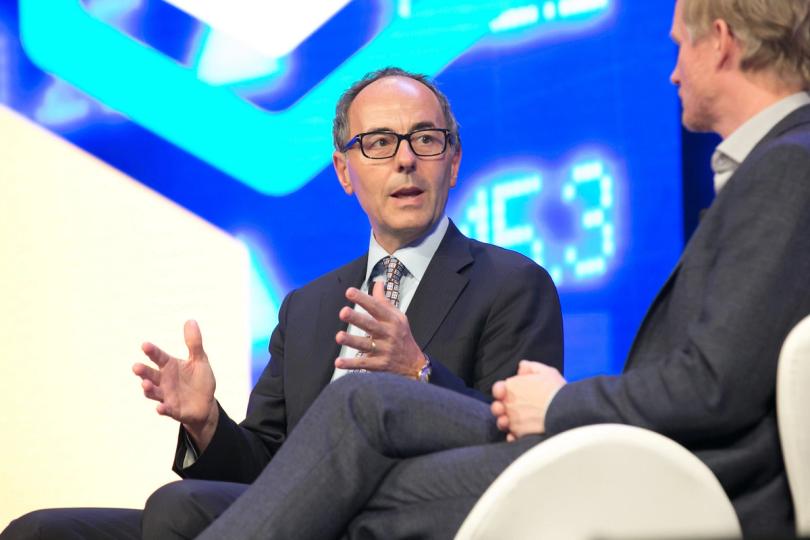
Bitcoin’s long-term design came under renewed scrutiny Friday after VanEck CEO Jan van Eck questioned whether the network provides sufficient encryption and privacy during an appearance on CNBC’s “Power Lunch” with anchor Brian Sullivan.
Van Eck said the issues attracting attention in the Bitcoin community go beyond short-term market fluctuations. “There is something else happening within the Bitcoin community that non-crypto people need to know about,” he said.
He added that VanEck assesses Bitcoin’s durability in the same way it assesses traditional assets. “At the end of the day, VanEck has existed before Bitcoin. We will walk away from Bitcoin if we think the thesis is fundamentally broken. We’re not doing that right now, but you always have to look at the underlying technology and the crypto.”
He didn’t define what he meant by the “Bitcoin thesis,” but his comments pointed to the foundations that support Bitcoin’s long-term viability, including the strength of its cryptography, the network’s readiness for advances in quantum computing, and whether its privacy model aligns with user expectations. His remarks centered on whether Bitcoin has “enough encryption” and “enough privacy,” which he said were now central questions for parts of the Bitcoin community.
Van Eck also said that some longtime Bitcoin holders and self-proclaimed maxis have started looking into Zcash, calling it “kind of related to Bitcoin with a lot more privacy.” He argued that Bitcoin’s transparent ledger may clash with rising expectations around transaction confidentiality. “When you move money around on the Bitcoin blockchain, you can see it,” he said. “You can see it moving from one purse to another.”
After the interview, van Eck posted a summary on X in which he argued that the current Bitcoin bear market reflects “the onchain reality of the halving cycle (bearish for 2026), concerns about quantum encryption and Zcash’s better privacy.” He also reinforced VanEck portfolio manager Pranav Kanade’s guidance for “dollar cost averaging in bear markets.”
Bitcoin was trading around $84,643 during the CNBC interview. From At 9:15 UTC on Sunday, November 23, the price was $86,204, up 2.4% in the past 24 hours, but down 7.7% year-to-date and 31.6% below the all-time high of $126,080 on October 6, 2025.
Industry reaction
Some voices in the broader crypto and research community echoed van Eck’s concerns.
On November 17, during a presentation on the Ethereum roadmap at the Devconnect conference in Argentina, Ethereum co-creator Vitalik Buterin warned that quantum computing could threaten elliptic curve cryptography, saying, “Elliptic curves will die.”
Separately, quantum computing researcher Scott Aaronson — the Schlumberger Centennial Chair of Computer Science at the University of Texas at Austin — wrote in a Nov. 13 blog post that “given the current dizzying rate of hardware progress,” it is “a viable possibility” that a fault-tolerant quantum computer capable of running Shor’s presidential election20 could be built into the next US presidential election20 algorithm 20.
Others reacted strongly against van Eck’s remarks. For example, Samson Mow, CEO of JAN3 and one of Bitcoin’s earliest advocates, dismissed the idea that Bitcoin maxis turning to privacy alternatives. In a post on X, he wrote: “You wouldn’t be able to point to a Bitcoin Maxi even if they were standing in front of you. You shouldn’t be talking about any Bitcoin at all. You’re a crypto guy, stay in your lane and push the latest shitcoin narrative.”
Zcash’s ZEC token has surged as privacy discussions intensify. ZEC is now the 13th most valuable cryptocurrency with a market cap of $9.43 billion and recently traded at $578.35, up 17.3% in the last 24 hours, 121.3% over the last 30 days and 930% year to date. On September 24, ZEC traded near $55.06.
Read more: “Inside Zcash: Encrypted Money at Planetary Scale”
Van Eck’s comments, alongside the broader debate about encryption, privacy and quantum contingency, suggest that the conversation around Bitcoin’s long-term architecture is likely to intensify as the market heads into 2026 and traders reassess the halving’s role in the current downturn.


