
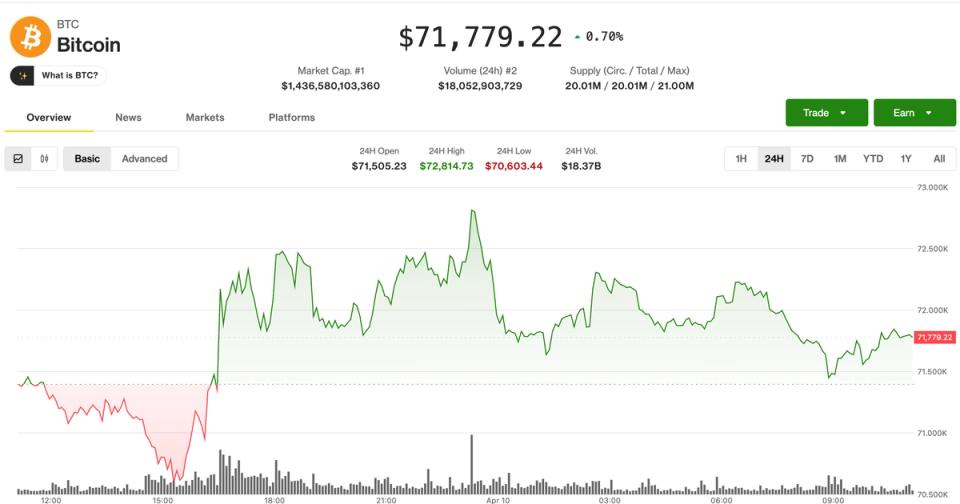
The crypto market held steady on Friday with bitcoin trading little changed at $71,700 and ether (ETH) at $2,180, extending the low-volatility price action that has characterized the past few months.
Daily Bollinger bands, a technical analysis tool that measures market volatility, are at their narrowest since early 2024. In the past, such a tight range — bitcoin has held between $63,000 and $75,000 since early February — has ended with a 40% move in price, according to cryptoanalyst Eric Crown.
A breakout above $75,000 in bitcoin’s case would trigger upward momentum by catching traders who are short and need to buy at market prices to cover their positions, while a short-term move below $70,000 would liquidate about $200 million worth of long positions betting on the breakout, according to CoinGlass’ liquidation heat map.
A key catalyst on Friday will be US Consumer Price Index (CPI) data. Inflation in March is estimated at 3.3% year-on-year, driven by rising energy prices. High inflation numbers tend to spur upward price action in the US dollar, which can weigh on risk assets like bitcoin.
Derivatives positioning
- Open interest (OI) in bitcoin futures rose 1%, with average perpetual funding rates on major exchanges at their highest since February 4. This shows a strengthening of investors’ appetite for bullish exposure.
- Other major cryptocurrencies were mixed. OI rose slightly in XRP (XRP), while it was flat in ether (ETH) and solana (SOL). HYPE and AVAX are other standouts that show a bullish combination of OI growth and positive funding rates.
- The privacy-focused ZEC, meanwhile, is showing OI growth and negative rates, a sign that traders continue to short futures and hedge downside risks even as the spot price rises. ZEC’s price rose to nearly $400, the highest since January 28.
- There appears to be no end to the downtrend in BTC’s 30-day implied volatility index, BVIV. The reading has fallen to 45%, indicating calm in the market. It has fallen almost flat from 58% on 31 March. Ether’s volatility index shows a similar pattern.
- The drop in volatility is largely driven by ETF-related flows. “The ETF complex has created a feedback loop: institutions sell calls for yield, which suppresses upside vol, making selling more calls even more attractive. The impact is still subtle, but the direction of travel is clear. Bitcoin’s options market is maturing into a structurally skewed market, just like stocks,” STS Digital CEO Maxime Seiler told CoinDesk.
- The implied volatility structure is flat for the next six months and then rises from September, suggesting the market is preparing for a few quiet months in between.
- On Deribit, BTC and ETH options continue to show bias, although much weaker than a week ago, as traders chase upside bets, especially the BTC call option at the $80,000 strike.
Token talk
- CoinDesk’s DeFi Select Index (DFX) is the best-performing benchmark on Friday, rising 0.38%, while the bitcoin-dominant CoinDesk 5 (CD5) is down a quarter of a percent.
- The CoinDesk Computing Select Index (CPUS) is the worst performer, losing 1.4% after being dragged down by bittensor (TAO), which has lost more than 12% since midnight UTC after Covenant AI, one of the network’s largest subnet developers, said it was leaving Bittensor.
- “The whole premise of Bittensor, the promise that drew builders, miners, validators and investors into this ecosystem, is that no single entity controls it,” Covenant AI founder Sam Dare wrote on X. “That promise is a lie.”
- One token that shrugged off broader apathy in the crypto market was DASH, which rose more than 19% since midnight UTC, contributing to a 24-hour gain of 34% as traders rotated back into the privacy sector.


