
Ministers are portraying it as diplomacy, while critics warn the plan centralizes control and sidelines the Palestinian Authority
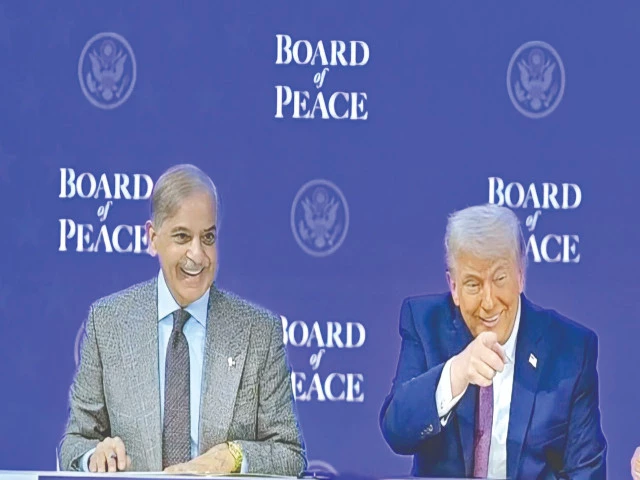
US President Donald Trump shares a lighter moment with Prime Minister Shehbaz Sharif during the unveiling of the ‘Board of Peace’ on the sidelines of the World Economic Forum’s annual meeting in Davos. Photo: Express
KARACHI:
Pakistan’s decision to join the US-led “Board of Peace” linked to Gaza has drawn sharp criticism from opposition parties and religious groups, who say the government has signed up without taking parliament or the public into confidence.
The State Department said Pakistan accepted an invitation from US President Donald Trump to join the board, describing it as part of efforts to support a Gaza peace plan under a UN Security Council framework, reaffirming Islamabad’s position on a ceasefire, humanitarian aid, reconstruction and a path to an independent Palestinian state.
Prime Minister Shehbaz Sharif signed the document to join the board in Davos during the World Economic Forum.
But the move has become politically contentious because Israeli Prime Minister Benjamin Netanyahu is also said to have accepted an invitation to attend the same forum.
What is the board of directors?
The “Peace Council” is a transitional administration set up to oversee Gaza and implement the “Comprehensive Plan” aimed at ending the conflict in the region. The organization, which is headed by Donald Trump for life, has centralized transitional legislative, executive and judicial authority, with the mandate to ensure that Gaza becomes a “de-radicalized and demilitarized zone” that “poses no threat to its neighbors,” according to the document.
According to the document, membership of the Peace Board is free and “contributions are voluntary.”
The board’s management structure includes an executive board, which is empowered to issue resolutions, establish subcommittees and make delegations necessary to carry out the “master plan”. The executive may “enact new law or amend or repeal” previous civil and criminal laws in Gaza, subject to the president’s approval, guidance and control.
It also includes a High Representative for Gaza, who has the power to issue immediate orders and directives, manage reconstruction and oversee the administration of justice and humanitarian aid.
An “approved, technocratic, apolitical committee of competent and qualified Palestinians” will be in the National Committee for the Administration of Gaza (NCAG), tasked with providing public service and administration, although it will remain under the direct supervision of the High Representative. Although presented as a local governing body, NCAG’s role is limited to implementation, with real authority vested in the Peace Council and the High Representative.
The ISF will initially be led by the United States to carry out its mission according to the plan, along with supplies to humanitarian zones and controlled civilian protection corridors patrolled by the force. The ISF will be under the direction of Force Commander (FC) Major General Jasper Jeffer of the United States, who has “operational authority” over the ISF.
The Chairman has the authority to approve and replace the FC at will.
The document includes a clause that says “no one will be forced to leave Gaza” and that those who leave are free to return. The document adds that resources, aid and political participation in Gaza are conditional on compliance with the “comprehensive plan.”
The tripartite government structure allows Trump to be the sole power that signs resolutions that go into effect, authorizes military movements for the International Stabilization Force (ISF), and appoints individuals to key positions in the apparatus.
Pakistan does not have a representative in the Gaza executive.
For the full document, see here:
‘Peace from murderers is self-delusion’
In a National Assembly debate, Jamiat Ulema-e-Islam (Fazl) (JUI-F) chief Maulana Fazlur Rehman condemned the decision and questioned how Pakistan could join a forum that included Netanyahu.
Read: The government is selling Gaza’s board access as diplomacy
“The same forces that created the problem are now sitting in judgment,” he said. “To expect peace from Trump was to live in a fool’s paradise.”
Fazlur Rehman also pointed out that the board’s reported focus was a concern, saying that disarming Hamas would mean dismantling Palestinian resistance. He urged parliament to reject the board in its current form and called for a formal resolution against it.
The JUI-F chief said linking hopes for peace and a better future for the Palestinians with a Trump-led board would amount to “deceiving ourselves” while citing Palestinian suffering and casualties in Gaza.
Jamaat-e-Islami’s emir Hafiz Naeemur Rehman also rejected Pakistan’s participation, saying such a major foreign policy decision was taken without consulting parliament, the cabinet or the public.
Read more: JI rejects Pakistan’s role in Trump’s ‘Board of Peace’
He described the initiative as “a new form of colonialism” and said Pakistan’s armed forces should not be sent to Gaza “under any circumstances”.
Pakistan Tehreek-e-Insaf (PTI) leaders demanded that the terms and conditions of participation be made public and that parliament be taken into confidence, with PTI chairman Barrister Gohar Ali Khan questioning whether Pakistan could be expected to play any role in dealing with Hamas.
The PTI also issued a formal rejection of the decision, arguing that moves of such international significance should be made transparently and through broad political consultation.
In addition, Reuven said no in an NDTV interview with the Israeli ambassador to India when Ambassador Reuven Azar was asked if he would be okay with Pakistan’s involvement in the stabilization force.
Israeli Ambassador Reuven Azar says Israel will not allow Pakistan to be part of any stabilization force in Gaza because of its pro-Palestinian stance.
ISRAEL FEAR PAKISTAN! 🔥🇵🇰 pic.twitter.com/ooYadus93S
— Zard si Gana (@ZardSi) 9 January 2026
Engagement avoids isolation
Despite Pakistan’s adherence to the “Peace Council” and the concerns of some political parties, government ministers have defended the decision as a diplomatic opening rather than a change of principle.
Planning Minister Ahsan Iqbal said Pakistan’s participation was limited to efforts aimed at peace in Palestine and insisted Islamabad had not recognized Israel. He has also argued that Pakistan’s involvement, along with other Muslim countries, strengthened peace efforts in Gaza.
Defense Minister Khawaja Asif said Pakistan should attend so it is not “irrelevant” in decisions that may follow, adding that the presence would allow Islamabad to raise its voice for the Palestinians.
Deputy Prime Minister Ishaq Dar has also dismissed reports that Pakistan will join the stabilization force to disarm Hamas.


