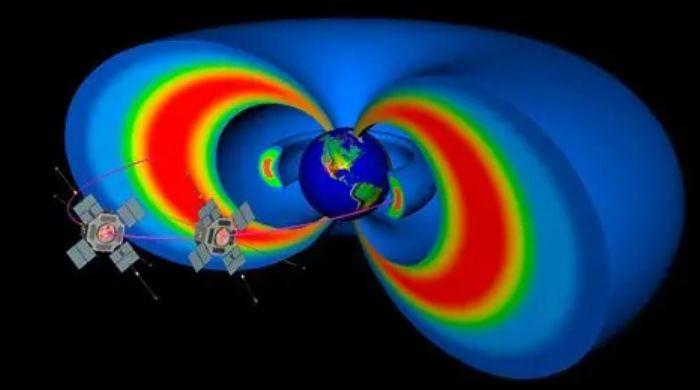
NASA’s 1,300-pound satellite is set to hit Earth’s surface today, March 10, 2026, after orbiting Earth for more than a decade now.
NASA has issued a statement announcing that “Van Allen Probe A is expected to re-enter Earth’s atmosphere nearly 14 years after launch.”
The roughly 1,323-pound (600-kilogram) Van Allen Probe A spacecraft was launched into orbit in August 2012 along with its pair, Van Allen Probe B, to conduct science experiments on the so-called radiation belts around Earth.
For context, the radiation belts known as the Van Allen belts were discovered by renowned physicist James Van Allen.
But according to NASA, both missions were abandoned in 2019, and Van Allen Probe A’s time away from Earth is almost over.
When will 600 kg NASA satellite crash on Earth?
According to details from the US Space Force, the satellite is expected to re-enter the Earth’s atmosphere today, Tuesday, March 10, 2026 at 19:45 EDT (23:45 GMT), plus or minus 24 hours.
According to NASA, there is no imminent danger to humans amid its re-entry into Earth’s atmosphere.
The statement added: “NASA expects most of the spacecraft to burn up as it travels through the atmosphere, but some components are expected to survive re-entry. The risk of injury to anyone on Earth is low, approximately 1 in 4,200.”
So this means that the low risk of damage is about 0.02%, while taking into account that water covers about 70% of the Earth’s surface.
Any debris that survives is likely to fall into the ocean, away from cities and land.
The Van Allen Probes satellites were set for a two-year timeline, but the spacecraft managed to continue operating without failure until 2019 (Probe B) and October 2019 (Probe A).
They were the first spacecraft manufactured to study the radiation belts for many years within an area around our Earth.
It is known as an area where most spacecraft and astronaut missions minimize time to avoid harmful radiation.