
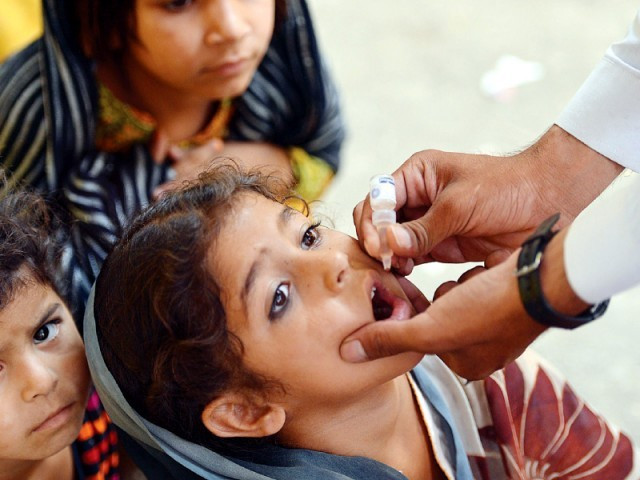
Forty thousand Karachi families refused polio vaccines this year. In a city where the virus circulates through every district, these refusals represent the gap between Pakistan’s impressive polio infrastructure and its inability to close the last mile of eradication.
Pakistan has reduced polio cases by more than 99.6% since 1994 – from 20,000 annual cases to just 30 this year. It has built one of the world’s most comprehensive monitoring systems: 127 environmental sampling sites, 12,500 reporting sites and campaigns reaching 45 million children. Two of three global poliovirus strains have been eliminated.
But Pakistan and Afghanistan remain the only countries where polio still circulates. And in 2024, the WPV1 strain re-emerged in 90 districts, forcing authorities to revise their approach with a “2-4-6 roadmap” under the National Emergency Action Plan.
“The last mile is actually very difficult to reach,” said Dr. Azra Pechuho, Sindh Minister for Health and Human Welfare, who spoke at the Aga Khan University on Friday. “It’s the small pockets we’re missing, as the number of infected children falls.” A two-hour event brought together the top names in Polio from WHO, Sindh Government, Federal Government and AKU.
Environmental tests confirm what health officials already know: the virus persists in underserved communities that vaccination campaigns struggle to reach. Every district of Sindh shows continuous transmission.
The 42,000 vaccine refusals in Sindh – 40,000 of them in Karachi – reflect what Dr. Azra calls it “vaccination fatigue.” But Dr. Sebastian Taylor of the Technical Advisory Group for Polio Eradication warned against assuming families are refusing because of too many vaccines. Many refusals stem from a lack of knowledge rather than vaccine overload, he said.
The WHO reports that authorities have narrowed the gap, reducing missing children from 1.48 million to 1.13 million. But low routine immunization coverage, vaccine hesitancy and population movements continue to leave spaces where the virus survives.
South Khyber Pakhtunkhwa poses the most pressing challenge. “This is where we have to do something really fast and really hard,” said Professor Shahnaz Ibrahim, chairman of the National Certification Committee, which annually decides whether Pakistan qualifies as polio-free.
The certification process requires three consecutive years with no cases and no environmental detection of the virus — and Pakistan cannot achieve that alone. “It has to be both Pakistan and Afghanistan as one entity,” explained Prof. Ibrahim.
The Prime Minister’s Polio Eradication Focal Point, Ayesha Farooq, noted that WPV1’s genetic diversity is “increasingly squeezed”, meaning less chance of new strains emerging. Dr. Azra said eradication can still be achieved if Pakistan maintains focus in the upcoming low transmission season.
“For the students today, you don’t need to study smallpox. It’s history,” said Aziz Memon, national chairman of Pakistan’s PolioPlus Committee. “Let’s put polio in the history books.”


