
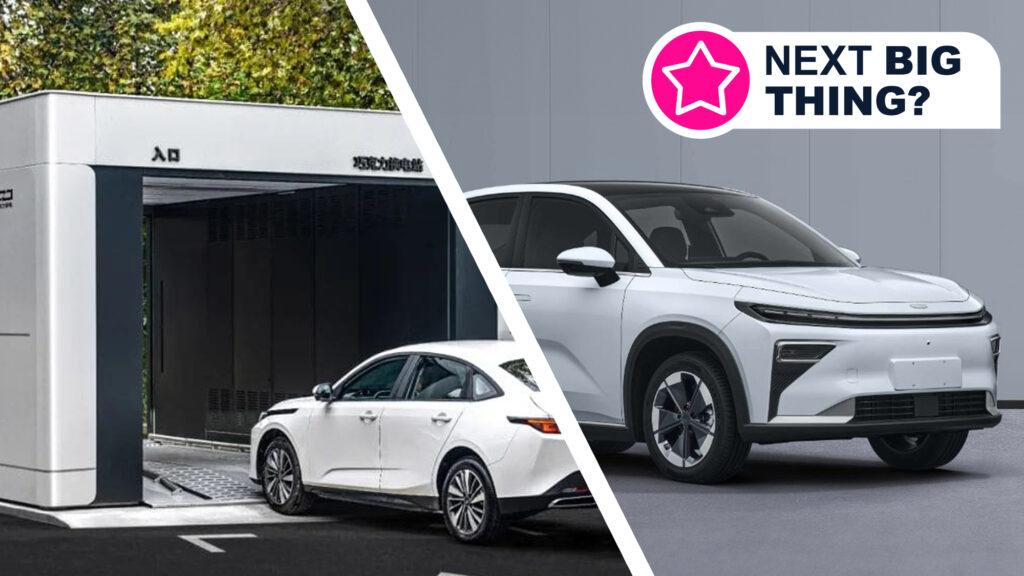
News has emerged from China that Geely is ready to release the world’s first range hybrid vehicle, which is also compatible with the country’s growing network of battery-dip stations.
BADGED HAOYUE R7, car news China says that it is essentially a recovered version of Geely Livan 7 All-Electric Flagship SUV, which was among the first geely models to support battery swap.
The process of driving into a dedicated facility and having a robot that autonomously replace the entire battery pack has been pushed by CATL, China’s largest EV battery manufacturer, and the electric vehicle brand Nio, which has even begun to introduce facilities to parts of Europe.
It is reported that the upcoming Haoyue R7 will be compatible with CATL’s battery swap technology, which allows owners to either become juice-up from home, use the much faster public charging network or take advantage of battery-dim stations.
What’s more, the 1.5-liter, naturally aspirated petrol engine can act as a generator to charge the battery packs aboard longer travel.
No official range has not yet been released, but even the smallest battery pack on Livan 7 can manage almost 280 miles on a single charge, so when you take into account the range, it could easily control that double it.
While it is very much a niche driveline in the Chinese market, it will offer customers an unmatched choice of how they get around and open the idea of electric vehicles to more and try to prove that range anxiety should no longer be a problem.
Analysis: The more methods, the Merrier
According to a recent BBC report, Nio has now built over 3,300 battery swap stations in China, with the company that wants to expand across the country for the next few years.
Currently, a number of taxis, buses and heavy trucks use battery swap technology in China, as these vehicles tend to have more predictable movement patterns that make the whole process much easier to control.
But through progress in software, it also becomes far simpler for electric vehicle brands to control entire EV fleets, with the ability to find out which vehicle needs its batteries that are brimmed and what the most effective way to do this is.
Tesla, for example, was pioneering for a “connected” SuperCharger network that helps point drivers to the most accessible and fastest charger nearby, where the battery was preset for the most effective top-ups.
Battery swap stations are not only another quick method of getting drivers to move again (the process takes about five minutes), it can also drastically reduce the original cost of a new vehicle.
Geely says Haoyue R7 will be offered without the battery pack, allowing customers to pay a small monthly fee to rent the batteries and take advantage of CATL Battery Swap Network.
This has proven to be extremely popular among the Taiwanese company Gogoro’s battery swap network, which uses much smaller packages to operate two-wheel scooters, mopeds and smaller capacity motorcycles in a number of global markets.
Not only is the cost of that motorcycle far cheaper to buy directly – even when paired with partner Yamaha’s products – it is also more convenient, with users who are able to pull up to a station, replace batteries by hand (no robots are needed as the packages are so small) and get on the way.


