
On World Water Day, leadership highlights water scarcity, gender inequality and dam projects to secure future supplies
ISLAMABAD:
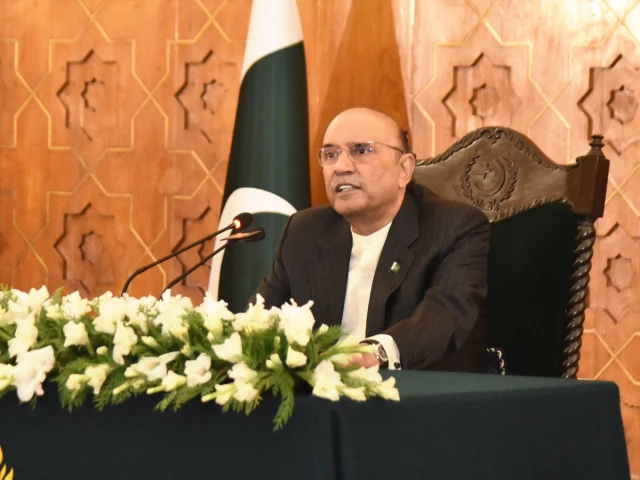
President Asif Ali Zardari called on India to immediately restore the full implementation of the Indus Waters Treaty (IWT) in line with international obligations.
In an announcement on World Water Day, he reiterated Pakistan’s strong condemnation of what he described as India’s unilateral suspension of the treaty.
“This deliberate weaponization of shared water resources is a matter of deep concern. India’s decision to suspend the treaty, disrupt hydrological data sharing, obstruct agreed mechanisms and undermine both the letter and spirit of a long-standing international agreement that has governed equitable sharing of the Indus river system for over six decades,” he said.
He added that such behavior threatened food security and economic security, threatened the livelihoods of millions who depended on these waters, and set a dangerous precedent for the management of transboundary resources under international law.
Referring to the theme of World Water Day, “Water and Gender”, the President said that water insecurity is not experienced equally, with women and girls often bearing the heaviest burden.
“In many parts of Pakistan, households still depend on distant or unreliable water sources. Women and girls spend many hours every day collecting water, time that could otherwise be spent at school, at work or with their families,” he said.
He added that the absence of clean water also posed health risks and put additional pressure on household life, stressing that solving the problem was a matter of equity and opportunity.
Zardari said access to clean water and sanitation was a fundamental right recognized in the constitution and must remain a national priority, requiring effective management of water resources, investment in water systems and greater participation of women in planning and decision-making.
Read: Pakistan warns against water weapons at UN, rejects India’s IWT stance
He also highlighted the role of the community, saying households could adopt rainwater harvesting and other simple measures to collect and store water, help replenish underground aquifers and raise the water table.
“Water sustains our agriculture, our cities and our natural environment. As pressure on water resources grows due to population needs and climate variability, we must use water more carefully,” he said.
Similarly, Prime Minister Shehbaz Sharif said the government considered access to clean water a fundamental human right and was committed to ensuring women’s representation in water management and decision-making processes.
In a message on World Water Day, he said the day was observed in Pakistan and around the world under the theme “Water and Gender Equality: Where Water Flows, Equality Grows”, highlighting that water conservation was not only a technical problem but also a matter of social justice and gender equality.
The prime minister said that Pakistan was facing the challenge of water scarcity and noted that the per capita availability of water had declined from 5,260 cubic meters to less than 1,000 cubic meters since the country’s formation.
He added that unpredictable rainfall patterns and changes in glacier systems due to climate change had further exacerbated the risks of water shortages.
Prime Minister Shehbaz said that water scarcity affected daily life, livelihood and social diversity in all sections of the society, where women have a greater responsibility to manage water at the household level.
He noted that difficulties in water availability consumed valuable time, especially in rural areas, affecting educational and economic activities.
The Prime Minister said the government was taking several reform measures under the National Water Policy to secure water resources for the future.
Read more: India’s water war
Under the public sector development programme, he said, the federal government was working on the construction of 18 small, medium and large dams to increase water storage.
These include major projects such as Diamer-Bhasha Dam and Mohmand Dam, which aim to increase storage capacity and supply drinking water.
He added that Naulong Dam and Nai Gaj Dam would improve agricultural irrigation while Greater Karachi Water Supply Scheme (K-IV) would improve water supply in Karachi.
The Chiniot Dam, he said, would provide water to Faisalabad, while the Kachhi Canal and Chashma Canal on the right bank would provide irrigation and drinking water to the plains of Kachhi and Dera Ismail Khan.
The Prime Minister said these projects would play a significant role in increasing water availability, addressing the effects of climate change and supporting sustainable economic development.
He added that alongside the dam construction, the government aimed to reduce water wastage by 33 percent and increase water efficiency by 30 percent by improving the canal system.
The Prime Minister said that the Indus River System Authority (IRSA) was installing a telemetry system across the country using modern technology to ensure transparency in the water system and it is expected to be completed by 2027.
Read also: IWT violations: NA panel chief calls for action
He said the system would enable timely monitoring of river flows and help resolve inter-provincial water distribution issues.
Pakistan was committed to protecting its national water rights at the global level and strongly condemned any water aggression, he said.
He said: “Today, on World Water Day, I appeal to all relevant institutions, development partners, civil society and all citizens to ensure the protection of water, considering it a precious gift. I reiterate my commitment at the government level that we will promote inclusive, sustainable and gender-sensitive management of water resources”.


