
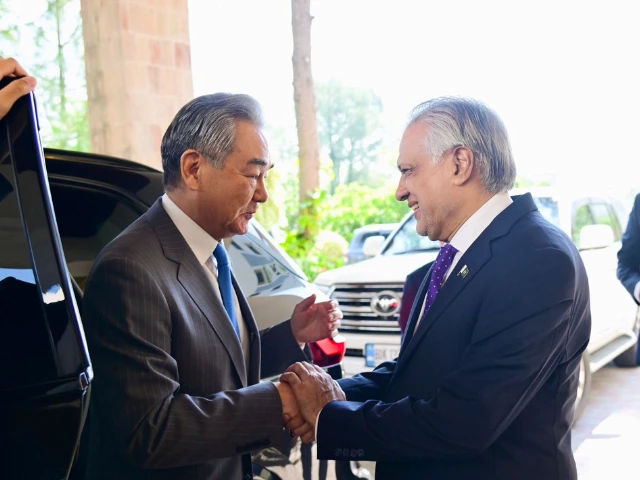
Dar, Wang Yi is to co-chair the seventh round of the Pakistan-China Foreign Ministers’ Strategic Dialogue
China and Pakistan will hold a crucial ‘strategic dialogue’ on Sunday as Deputy Prime Minister and Foreign Minister Senator Ishaq Dar reached the Chinese capital on Saturday, becoming the first top foreign diplomat to travel to Beijing in 2026.
He will co-chair the seventh round of Pakistan-China Foreign Ministers’ Strategic Dialogue with Chinese Foreign Minister Wang Yi against the background of several regional and international developments.
A senior foreign ministry official said the last strategic dialogue was held in August and the convening of the next one at such short notice highlights the close cooperation and consultation between the two ‘iron clad brothers’.
The forum will essentially discuss broader regional and international issues and work towards alignment of positions. The ongoing development, from South Asia to the Middle East and other global hotspots, makes the upcoming strategic dialogue between the two countries even more significant.
Read more: Dar heads to China for the 7th Foreign Ministers’ Strategic Dialogue
At Beijing International Airport, Dar was received by China’s Special Representative for Afghanistan, Ambassador Yue Xiaoyong, Pakistan’s Ambassador to China and senior officials from the Pakistan Embassy, reflecting the ceremonial and high-profile nature of the visit. The dialogue is scheduled for Sunday, and Dar is also expected to attend a series of commemorative events celebrating the long-standing partnership between Islamabad and Beijing.
The upcoming meeting represents the highest consultative mechanism between Pakistan and China, providing a structured platform to review the full spectrum of bilateral relations, including political, economic and security cooperation, as well as people-to-people exchanges. It also provides an opportunity to coordinate positions on regional and global developments of common interest.
According to the Ministry of Foreign Affairs, the strategic dialogue “constitutes an important part of regular high-level exchanges between Pakistan and China and reflects their shared determination to expand and deepen the all-weather strategic cooperative partnership”. It added that both sides remain committed to regional peace, stability and sustainable development.
The Pakistan-China Foreign Ministers’ Strategic Dialogue was institutionalized to provide a formal mechanism for comprehensive consultations on bilateral and regional issues. The upcoming seventh round follows the last meeting held in August 2025 less than five months ago, signaling the accelerated pace of high-level interactions between the two countries.
Deputy Prime Minister and Foreign Minister Senator Mohammad Ishaq Dar @MIshaqDar50 arrived in Beijing this evening. At the airport, he was received by China’s Special Representative for Afghanistan, Ambassador Yue Xiaoyong, Pakistan’s Ambassador to China and officers of Pakistan… pic.twitter.com/3Q3LzMC11o
— Ministry of Foreign Affairs – Pakistan (@ForeignOfficePk) 3 January 2026
Since the establishment of diplomatic relations in May 1951, Pakistan has been among the first countries to recognize the People’s Republic of China. Over the decades, ties have evolved into a multifaceted partnership characterized by strong political trust, close defense cooperation and expanding economic engagement. The relationship has survived several regional upheavals and global power shifts, with both countries often describing each other as ‘iron brothers’.
Beijing has consistently supported Islamabad on core issues, including the Kashmir dispute, while Pakistan has asserted China’s sovereignty and territorial integrity on the international stage. Defense cooperation and security coordination have remained integral elements of the bilateral partnership, which has strengthened both countries’ strategic stability in the region.
Economic cooperation, particularly through the China-Pakistan Economic Corridor (CPEC), has become a central pillar of bilateral engagement over the past decade.
Despite challenges such as global economic volatility and domestic constraints, both governments have reiterated their commitment to high-quality development of CPEC projects. The upcoming dialogue is expected to focus on strengthening industrial cooperation, promoting agricultural innovation, expanding information technology initiatives and pursuing green development projects in line with sustainable development goals.
Also read: Pakistan test-fires initially developed Taimoor cruise missile
The dialogue comes amid a rapidly changing regional security environment. Key issues likely to be on the agenda include the situation in Afghanistan following the political transition, ongoing tensions in the Middle East and the evolving strategic competition between major powers. Analysts suggest that both Islamabad and Beijing can discuss coordinated approaches to regional stability, multilateral diplomacy and security challenges in South and Central Asia.
In addition, the strategic dialogue provides an opportunity for both countries to exchange assessments of global developments, including post-pandemic economic recovery trends, energy security concerns, and new trade and technology partnerships. Observers note that Beijing’s increasing global economic and strategic reach aligns with Islamabad’s goal of stabilizing its economy while leveraging Chinese support for sustainable development.
A key highlight of Dar’s visit is the celebration of the 75th anniversary of diplomatic relations between Pakistan and China in 2026. The dialogue is expected to be accompanied by announcements of joint initiatives and commemorative activities that reflect decades of enduring trust and cooperation. From cultural exchanges to collaborative development projects, both sides plan to emphasize the historic significance of the partnership while charting its trajectory for the future.
“Seventy-five years of diplomatic engagement is a milestone that not only commemorates history but also affirms our shared vision for long-term cooperation,” the State Department said in its briefing. The anniversary celebrations are likely to include high-level dialogues, bilateral visits and sector-specific initiatives aimed at deepening people-to-people ties, trade and technological cooperation.
Dar’s visit follows a series of high-level engagements between Islamabad and Beijing in recent months, highlighting the momentum in bilateral relations. The regularity of these dialogues indicates the priority that both countries attach to strategic coordination and reflects mutual recognition of the geostrategic and economic benefits of close cooperation.
Read: Pakistan rejects Jaishankar remarks, defends Indus Waters Treaty stance
Although the dialogue is primarily consultative, experts expect practical results, including agreements on trade facilitation, energy cooperation, joint infrastructure projects and coordinated diplomatic strategies on regional security issues. The dialogue will also serve as a platform to reaffirm the ‘All-Weather Strategic Cooperative Partnership’ and advance the common interests of both nations in international fora.
Dar’s trip to Beijing underscores the enduring nature of Pakistan-China relations and the shared willingness to navigate regional and global challenges together. The strategic dialogue not only consolidates decades of trust and partnership, but also sets the stage for a future of expanded economic cooperation, strategic alignment and people-centered engagement between the two countries.


